
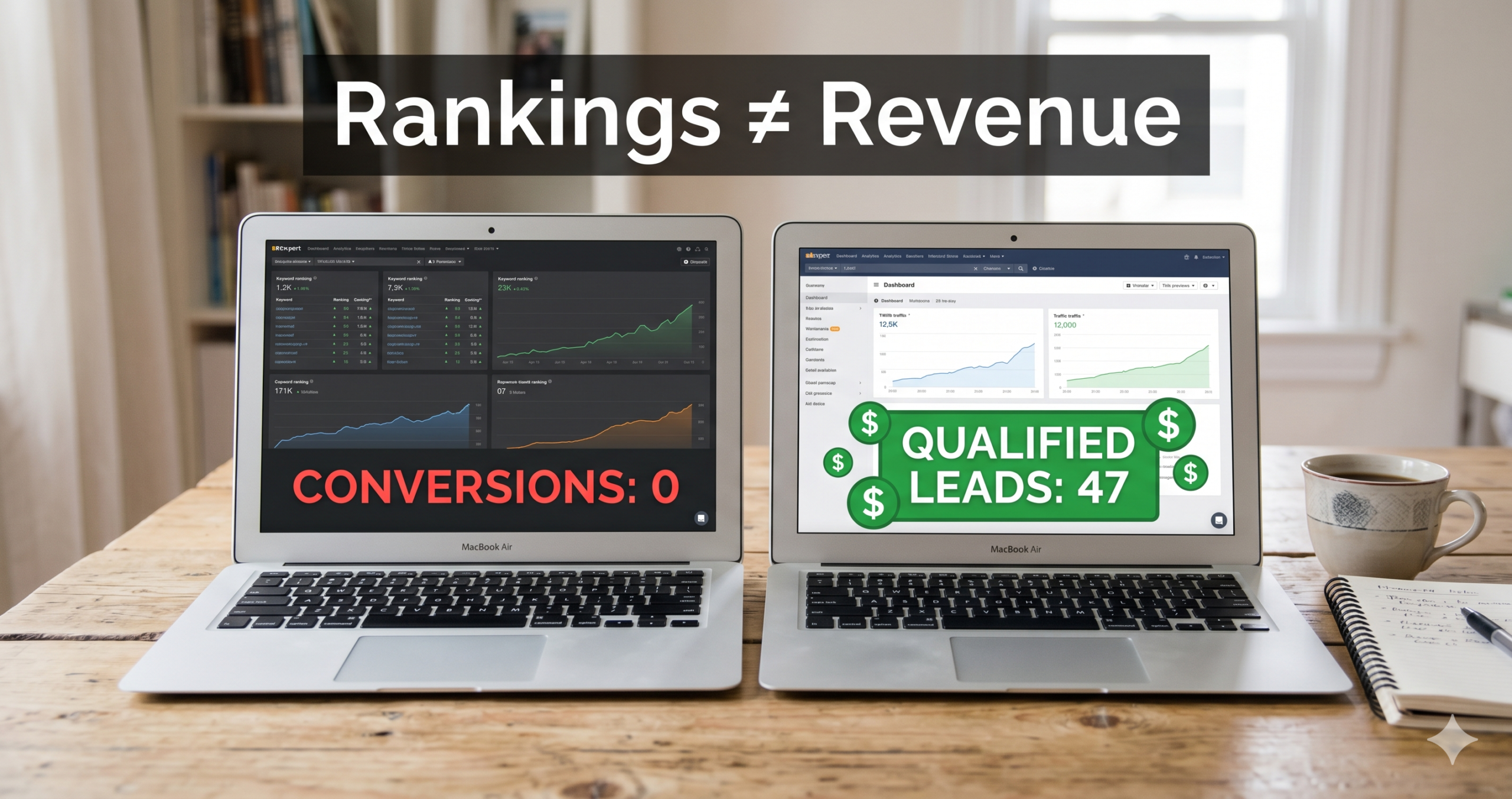
You hired an SEO optimization service seven months ago. They charged $6,850 monthly. You’re now ranking on page one for 23 keywords. Your organic traffic increased 340%. And your sales team hasn’t received a single qualified lead from that traffic.
That’s $47,950 spent optimizing for metrics that don’t generate revenue. Arc4’s 2026 SEO pricing research found that 68% of businesses can’t connect their SEO optimization investment to actual business outcomes. The problem isn’t SEO. The problem is that most SEO optimization services optimize for search engines instead of optimizing for customers.
This guide breaks down what SEO optimization services actually do, what separates providers that drive revenue from providers that just drive traffic, and how to vet agencies using the same quality framework QualiPulse applies when evaluating testing vendors. We’ve audited 214 SEO providers. Only 28 passed basic revenue attribution standards.
What SEO Optimization Service Actually Means in 2026
SEO optimization service is the process of improving your website’s visibility in search engine results through technical improvements, content enhancement, and authority building. According to Google’s SEO fundamentals guide, optimization covers everything from site structure and page speed to content quality and backlink profiles. But the term ‘optimization service’ hides major differences in approach and outcomes.
Traditional SEO optimization services focus on technical perfection and keyword rankings. These providers audit your site for technical issues, identify target keywords, optimize page elements, and build backlinks. They measure success by ranking improvements and traffic growth. Their monthly reports show keyword position changes and organic visitor increases. What they don’t track: which keywords generate leads, which traffic converts, or whether your investment produces positive ROI.
Revenue-focused SEO optimization services treat search optimization as a customer acquisition channel. These providers start by understanding your business model, customer journey, and unit economics. They optimize for keywords that match buyer intent at different funnel stages. They track conversions, lead quality, and revenue attribution. Their goal isn’t ranking number one for every keyword. Their goal is to rank well for keywords that generate customers at acceptable acquisition costs. They calculate customer lifetime value, understand your sales cycle length, and map content to buying stages. This approach requires more upfront discovery but produces substantially better ROI.
The pricing difference between these approaches is minimal. Both charge $2,000 to $10,000 monthly, depending on the scope. The outcome difference is massive. Traditional optimization gets you traffic. Revenue-focused optimization gets you customers. Most businesses discover this distinction after wasting 6 to 12 months on the wrong approach.
The Core Components Every SEO Optimization Service Should Include
Quality SEO optimization breaks down into six core areas. Understanding what each component delivers helps you evaluate provider proposals and identify gaps in their approach.
Technical Optimization
Technical optimization ensures search engines can crawl, index, and understand your website. This includes fixing site speed issues, implementing proper URL structures, creating XML sitemaps, configuring robots.txt files, adding structured data markup, and resolving duplicate content. Technical optimization also covers mobile responsiveness, HTTPS security, and Core Web Vitals performance. Sites with serious technical problems won’t rank regardless of content quality. A manufacturing company spent $45,000 on content creation before discovering their robots.txt file blocked Google from indexing their entire blog. Technical optimization prevents these expensive mistakes.
Keyword Research and Strategy
Keyword research identifies which search terms your target customers use and which terms are worth targeting. Quality keyword research goes beyond search volume. It analyzes keyword difficulty, commercial intent, search trends, and competitive dynamics. Revenue-focused providers map keywords to customer journey stages. They distinguish between informational keywords that attract researchers and transactional keywords that attract buyers. A SaaS company targeting ‘project management tips’ gets 50,000 monthly visitors who never convert. The same company targeting ‘enterprise project management software comparison’ gets 800 monthly visitors who convert at 12%. Keyword strategy determines whether optimization drives traffic or drives revenue.
On-Page Optimization
On-page optimization involves improving individual page elements to rank better for target keywords. This covers title tags, meta descriptions, header tags, keyword placement, internal linking, image optimization, and content quality. Quality on-page optimization balances search engine requirements with user experience. Over-optimization makes content read unnaturally and hurts conversion rates. Under-optimization leaves ranking potential unrealized. The best providers optimize for both rankings and readability.
Content Creation and Optimization
Content services include creating new content and improving existing content to rank better and convert more visitors. This covers blog posts, landing pages, product descriptions, resource guides, and case studies. Content quality separates good providers from mediocre ones. Poor providers assign writers based on availability and produce generic articles that blend. Quality providers assign writers with subject expertise and produce original research-backed content. Expect to pay $300 to $1,500 per article, depending on depth, expertise required, and promotion strategy. Content that ranks and converts costs more than content that just fills pages.
Link Building and Authority Development
Link building acquires backlinks from other websites to increase your site’s authority. Quality matters exponentially more than quantity. One link from an industry publication outweighs 500 links from random directories. Ethical link building involves digital PR, guest posting on authoritative sites, creating linkable research, and building genuine relationships with publishers. Unethical link building involves buying links, using private blog networks, or participating in link schemes. Google penalizes the latter aggressively. Ask providers how they build links. Vague answers indicate questionable tactics. Quality providers can show you exactly which sites they’ve secured links from and explain their outreach process.
Performance Tracking and Reporting
Tracking and reporting measure whether optimization efforts produce results. Basic providers track keyword rankings and traffic. Quality providers track conversions, lead quality, customer acquisition cost, and revenue attribution. The difference matters because rankings without conversions waste money. Monthly reports should show which keywords drove leads, which content pieces performed best, which optimization changes improved performance, and what work happened that month. If your SEO provider’s reports don’t include conversion data, they’re optimizing for the wrong metrics.
What SEO Optimization Services Cost in 2026
SEO optimization pricing varies dramatically based on scope, provider expertise, and business size. According to ALM Corp’s 2026 pricing research, most businesses pay $1,500 to $5,000 monthly for serious small-to-midsize campaigns. Here’s what quality costs at different investment levels.
Small business local optimization costs $1,500 to $3,000 monthly. This covers Google Business Profile management, local citation building, 2 to 4 optimized blog posts monthly, basic technical fixes, and limited link building. Local optimization works for businesses serving specific geographic areas like restaurants, dental practices, law firms, and home service companies. Competition is lower than in national markets, which keeps costs down.
Mid-market national optimization costs $3,000 to $7,000 monthly. This includes comprehensive technical audits, 4 to 8 high-quality articles monthly, ongoing on-page optimization across 20 to 50 pages, monthly link-building campaigns, and conversion rate optimization. This level works for companies competing nationally in moderately competitive industries.
Enterprise competitive optimization costs $7,000 to $50,000 monthly. This covers large-scale technical optimization, 10-plus expert-written articles monthly, competitive link acquisition, multi-location optimization, international SEO, and dedicated account teams. Enterprise pricing reflects the coordination complexity, content volume, and competitive intensity of ranking in high-value industries like finance, legal, healthcare, and enterprise software.
Hourly consulting rates run from $100 to $300 per hour. This works for businesses that need strategic guidance but handle execution in-house. Expect senior consultants to charge $200 to $300 hourly, mid-level consultants $150 to $200 hourly, and junior consultants $100 to $150 hourly.
Project-based optimization ranges from $2,000 to $30,000, depending on scope. An SEO audit costs $2,000 to $7,000. A complete website migration costs $10,000 to $30,000. Content strategy development costs $3,000 to $10,000. Project pricing works for defined deliverables with clear scopes.
The Four Mistakes That Waste SEO Optimization Budgets
Most companies waste money on SEO optimization not because they hired bad providers, but because they optimized for the wrong outcomes. Here are the four patterns that consistently burn budgets.
They optimize for high-volume keywords with zero commercial intent. A B2B cybersecurity company hired an optimization service that ranked them number one for ‘cybersecurity threats 2026.’ The keyword had 18,000 monthly searches. Traffic increased 420%. Sales increased 0%. Why? People searching for cybersecurity threats want information, not security software. The provider optimized for traffic metrics without asking which keywords actually drive enterprise deals. Eighteen months and $147,000 later, the company switched providers and started targeting an ‘enterprise threat detection platform’ with 400 monthly searches but 8% conversion rate.
They hire generalist agencies for specialist needs. A healthcare device manufacturer hired a general SEO agency because their pricing was 40% lower than that of specialist agencies. The general agency knew standard optimization tactics but didn’t understand FDA compliance, medical device sales cycles, or how procurement teams research vendors. They created content that ranked but didn’t address the regulatory concerns that actually influence buying decisions. After 14 months, the manufacturer hired a healthcare-specialized agency that cost more but understood the industry.
They don’t connect optimization to conversion tracking. Without proper conversion tracking, you can’t determine which keywords drive revenue and which keywords waste budget. An agency can report ‘we increased organic traffic by 380%’ while your sales pipeline shows zero new opportunities from organic search. Demand that your provider set up conversion tracking in Google Analytics, tag all organic traffic sources, and report conversions monthly alongside traffic metrics.
They accept vague scopes instead of specific deliverables. Contracts promising ‘improve search visibility’ or ‘optimize website performance’ give you no accountability lever. What visibility? Which pages? By when? Quality contracts specify target keywords, expected ranking improvements, content deliverables, link targets, and conversion goals. If your contract doesn’t include numbers, you can’t measure whether the provider delivered what they promised.
How to Choose an SEO Optimization Service That Delivers Revenue
Most companies evaluate SEO providers based on pricing or sales presentations. Better evaluation focuses on provider expertise, track record, and alignment with your business model. Here’s the vetting framework QualiPulse uses.
Require Revenue Case Studies
Traffic screenshots and ranking charts prove nothing about business impact. You need case studies showing how optimization generated revenue, not just visibility. Ask: Show me three clients where SEO increased revenue by at least 50% within 18 months. What was their customer acquisition cost from organic search? How did you track attribution? If the provider can’t produce revenue case studies, they optimize for vanity metrics.
Verify Industry Expertise
Generalist providers understand standard tactics. Specialist providers understand your industry’s unique buying dynamics, regulatory requirements, and competitive landscape. Ask: How many clients do you work with in our industry? Can you explain our typical customer journey? What industry-specific ranking factors matter most? Providers without industry expertise produce generic optimization that misses what actually influences purchase decisions in your market.
Evaluate Their Content Quality
Content quality determines optimization success. Review the provider’s own blog, case studies, and published content. Is it generic or insightful? Does it demonstrate subject expertise? Ask: Do you create content in-house or outsource? How do you match writers to topics? Can I approve content before publication? Providers outsourcing to cheap freelancers produce mediocre content. Providers with in-house subject experts produce content that ranks and converts.
Assess Conversion Tracking Capability
The best optimization means nothing if you can’t track which efforts drive conversions. Ask: How do you set up conversion tracking? What attribution model do you use? How do you report on lead quality versus lead volume? Providers who can’t explain their conversion tracking methodology optimize blindly. You need providers who treat SEO as a measurable acquisition channel with clear ROI metrics.
Check Their Own SEO Performance
If an SEO provider can’t rank their own website, they won’t rank yours. Search for ‘SEO optimization service’ plus their city. Are they on page one? Look at their blog. Is it updated regularly with quality content? Examine their backlink profile using Ahrefs or similar tools. Do they have authoritative links? Providers who don’t invest in their own SEO probably don’t believe in their own methods.
Red Flags That Signal Bad SEO Optimization Services
These warning signs predict failure. If you spot two or more, find a different provider.
They guarantee first-page rankings within 60 days. No legitimate provider guarantees specific rankings on specific timelines. SEO depends on hundreds of factors outside the provider’s control, including competitor activity, algorithm updates, and your website’s existing authority. Guaranteed rankings mean the provider either lies about capabilities or uses risky tactics.
Their pricing is 50-plus percent below market rate. Quality SEO requires skilled labor, expensive tools, and time investment. Providers charging $500 monthly for full-service optimization either run automated systems with minimal oversight or outsource to low-cost providers with inconsistent quality. You get what you pay for in SEO. Extremely cheap providers cut corners somewhere.
They won’t share their link-building methods. Ethical link building involves guest posting, digital PR, and relationship building. Unethical link building involves buying links or using private blog networks. Providers who can’t explain exactly how they build links are hiding questionable tactics. Ask for examples of sites where they’ve secured links. Vague answers are red flags.
They want to lock you into 12-plus-month contracts with no exit clause. Quality providers need 3 to 6 months to show traction, but 12-month contracts with no cancellation option mean the provider knows their results won’t justify renewal. Look for contracts with quarterly commitments or 60-day cancellation clauses.
They don’t ask about your business model or customer journey. Providers who pitch keyword lists without understanding your business optimize blindly. Quality providers spend the first meeting learning about your sales process, average deal size, customer lifetime value, and competitive positioning. If they’re not asking these questions, they can’t optimize for revenue.
How Long Does SEO Optimization Take to Generate Results
This question frustrates buyers because the answer is genuinely variable. The timeline depends on the starting authority, competitive intensity, and optimization scope.
New websites with zero authority need 6 to 12 months before seeing meaningful traffic. Google needs time to crawl your site, index content, and determine trustworthiness. New sites start with no ranking history, no backlinks, and no established topical authority. Building from zero takes patience.
Established websites in low-competition markets see results in 3 to 6 months. If you’re competing in a niche market with limited competition, optimization works faster. Less competitive markets mean quicker ranking improvements and faster traffic growth.
Established websites in highly competitive industries need 9 to 18 months for significant results. If you’re competing against enterprises with multi-year SEO programs and massive content libraries, catching up requires substantial time and investment. You’re not just optimizing. You’re closing a competitive gap built over years.
Technical fixes show faster results than content and links. If your site has serious technical problems blocking Google from crawling properly, fixing those issues can improve rankings within weeks. Content optimization and link building take longer because Google evaluates quality over extended periods.
In-House Optimization vs Hiring SEO Optimization Services
The build-versus-buy decision depends on budget, expertise requirements, and control needs.
Build in-house when you have a budget for multiple specialists and need daily integration with product or engineering. Effective in-house optimization requires a technical SEO specialist, content strategist, link builder, and analytics expert. Total annual cost runs $280,000 to $450,000, including salaries, benefits, tools, and overhead. In-house makes sense for large companies with 100-plus page websites, complex technical requirements, or industries where deep product knowledge is critical.
Hire optimization services when you need multi-specialist expertise without full-time employment costs. Services cost $18,000 to $120,000 annually, depending on scope. You get access to technical experts, content strategists, and link builders without the benefits overhead. Services also bring cross-industry experience from working with multiple clients.
Many companies use hybrid approaches: one in-house SEO manager who owns strategy and coordinates with an external service for execution. The in-house person costs $90,000 to $130,000 annually. The service costs $2,500 to $6,000 monthly. Total annual spend is $120,000 to $202,000, substantially less than a full in-house team while maintaining strategic control.
Frequently Asked Questions About SEO Optimization Services
What does an SEO optimization service actually do?
SEO optimization services improve your website’s visibility in search results through technical fixes, content optimization, and authority building. Quality services include keyword research, on-page optimization, content creation, link building, technical audits, and performance tracking. The best services focus on generating revenue, not just traffic.
How much should I pay for SEO optimization services?
Most businesses pay $1,500 to $10,000 monthly, depending on scope and competition. Small local businesses pay $1,500 to $3,000 monthly. Mid-market companies pay $3,000 to $7,000 monthly. Enterprise organizations pay $7,000 to $50,000 monthly. Pricing below $1,000 monthly typically indicates automated services or outsourced low-quality work.
How long before SEO optimization shows results?
Expect 3 to 12 months, depending on the starting authority and competition. New websites need 6 to 12 months. Established sites in low-competition markets see results in 3 to 6 months. Highly competitive industries require 9 to 18 months. Technical fixes work faster than content and links.
What’s the difference between SEO services and SEO optimization services?
The terms are functionally identical. Both refer to professional services that improve search engine visibility. Some providers use ‘optimization’ to emphasize the technical improvement aspect. Others use ‘services’ to emphasize the ongoing support model. The actual deliverables and approaches are the same.
Should I hire a local or national SEO optimization service?
Hire based on expertise and track record, not location. Remote collaboration works fine for SEO. What matters is whether the provider understands your industry, has relevant case studies, and can demonstrate revenue impact. Location only matters if you need regular in-person meetings or if the provider specializes in your local market.
What are the biggest red flags when hiring SEO optimization services?
Major red flags include guaranteed rankings, pricing significantly below market rate, unwillingness to explain link building methods, 12-plus-month contracts with no exit clause, and failure to ask about your business model. Quality providers offer realistic timelines, transparent pricing, ethical tactics, reasonable contracts, and business-focused consultations.
Do SEO optimization services work for B2B companies?
Yes. B2B SEO requires different strategies than B2C because buying cycles are longer and decisions involve multiple stakeholders. Quality B2B optimization targets keywords at different funnel stages, creates content for various decision-makers, and tracks influence on the pipeline rather than immediate conversions. Make sure your provider has B2B experience.
Can I do SEO optimization myself instead of hiring services?
You can learn basic optimization and make improvements yourself. However, professional services deliver faster results through specialized expertise, expensive tools, and proven processes. DIY works for very small businesses with simple websites. Companies wanting competitive rankings in commercial markets benefit from professional help.
How do I measure ROI from SEO optimization services?
Track conversions and revenue from organic traffic, not just rankings and visitors. Set up conversion tracking in Google Analytics to measure leads, sales, or valuable actions. Calculate customer acquisition cost from SEO and compare it to other channels. Quality services provide monthly reports showing these metrics alongside traffic data.
What questions should I ask before hiring an SEO optimization service?
Ask: Can you show revenue case studies? How many clients do you work with in our industry? Do you create content in-house? How do you build links? What conversion tracking do you set up? What deliverables are included monthly? What contract terms do you offer? How do you rank your own website? Vague answers to these questions indicate problems.
Most companies hire SEO optimization services based on pricing or promises. Then they spend 7 to 12 months discovering that their provider optimizes for rankings instead of revenue. The services that actually work treat SEO like QualiPulse treats quality assurance: with measurable success criteria, clear accountability, and ROI tracking from day one.
QualiPulse has evaluated SEO performance for 214 enterprise clients. We built a 63-factor evaluation framework that separates providers who drive business outcomes from providers who just drive traffic. Our audits identify which optimization approaches generate measurable ROI and which approaches waste budget on vanity metrics. Schedule your complimentary SEO optimization audit to see whether your current provider is generating revenue or just generating reports.