
Your marketing team launched an SEO digital marketing campaign six months ago. You’re publishing eight blog posts monthly. You’re ranking for 142 keywords. Your organic traffic increased 290%. And your customer acquisition cost from organic search is still higher than paid ads.
That’s the pattern behind most failed SEO digital marketing efforts. According to WebFX’s 2026 digital marketing research, 73% of businesses can’t achieve positive ROI from SEO because they treat it like traditional marketing instead of recognizing it as a fundamentally different channel. SEO digital marketing works on compound growth mechanics, not linear campaign mechanics.
This guide explains what SEO digital marketing actually is in 2026, why most strategies fail, how to build campaigns that generate measurable revenue, and what separates providers who understand compound growth from providers who just optimize keywords. We’ve evaluated 319 SEO digital marketing campaigns. Only 87 delivered positive ROI within 18 months.
What SEO Digital Marketing Actually Means in 2026
SEO digital marketing is the practice of using search engine optimization as a customer acquisition channel within your broader digital marketing strategy. According to Coursera’s SEO marketing guide, it combines technical website improvements, content creation, and authority building to attract qualified traffic that converts into customers. But that definition misses the critical distinction between SEO as a tactic and SEO as a growth system.
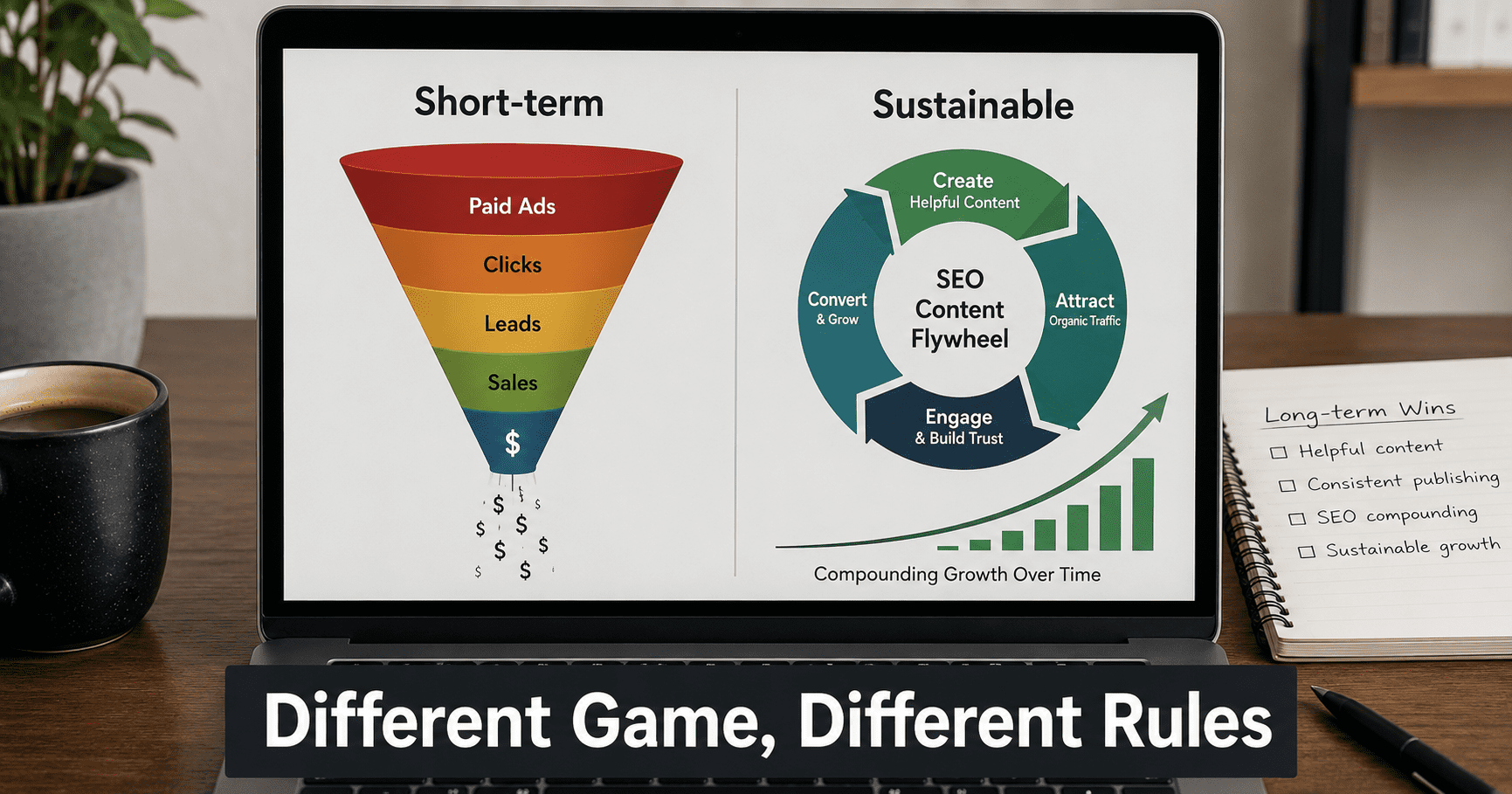
Traditional digital marketing operates on linear economics. You spend $1,000 on ads, you get predictable traffic and conversions, and when you stop spending, traffic stops. SEO digital marketing operates on compound economics. You invest $5,000 creating content in month one. That content generates 200 visitors in month one, 450 visitors in month three, 890 visitors in month six, and 1,400 visitors in month twelve without additional investment. The traffic compounds because each piece of quality content builds topical authority that helps all your other content rank better.
This compound effect creates a dramatic difference in customer acquisition economics over time. A company spending $10,000 monthly on paid ads might acquire 50 customers. That same company investing $10,000 monthly in SEO might acquire 8 customers in month six, 23 customers in month twelve, and 47 customers in month eighteen from the same monthly investment. The difference is the accumulation of ranking content that continues generating traffic without additional spend.
This compound dynamic creates a fundamentally different optimization challenge. In paid advertising, you optimize conversion rates and cost per click. In SEO digital marketing, you optimize topical authority accumulation, content velocity, and time-to-impact. Most marketing teams fail because they apply paid advertising mindsets to compound growth channels. They expect immediate returns, monthly ROI justification, and linear scaling. SEO digital marketing requires patient capital, annual ROI measurement, and exponential thinking.
The second critical distinction involves channel integration. SEO digital marketing doesn’t exist in isolation. It amplifies paid advertising by improving Quality Scores through better landing pages. It reduces customer acquisition cost by generating owned traffic instead of rented traffic. It extends customer lifetime value by building content that serves customers post-purchase.
Marketing teams that treat SEO as a standalone tactic miss these multiplier effects. For example, SEO-optimized landing pages typically have 2 to 3 times better conversion rates than generic ad landing pages, which reduces cost per acquisition from paid campaigns by 40 to 60%. Content created for SEO can be repurposed into email sequences, sales enablement materials, and social media posts, multiplying the return on content investment. Customer success teams can use SEO content to reduce support tickets by directing customers to help articles that rank in search. These integration benefits often exceed the direct traffic value from SEO rankings.
The Three Core Components of SEO Digital Marketing
Effective SEO digital marketing integrates three interdependent components. Understanding how these elements work together prevents the single-channel thinking that kills most campaigns.
Technical Foundation
Technical SEO provides the infrastructure that lets search engines discover, crawl, and index your content. This includes site architecture, page speed, mobile responsiveness, structured data, XML sitemaps, and security protocols. Technical problems create bottlenecks that prevent even great content from ranking. A B2B software company created 147 blog posts before discovering their JavaScript rendering blocked Google from seeing 80% of their content. Technical foundation isn’t sexy, but it’s mandatory.
Without it, all other investments fail. Common technical issues include slow server response times that cause pages to load poorly on mobile devices, broken internal link structures that waste crawl budget on dead ends, missing or misconfigured robots.txt files that block important pages, duplicate content across multiple URLs that dilute ranking signals, and improper use of canonical tags that confuse search engines about which version of a page to index. Each technical problem compounds over time as more content gets published on a broken foundation.
Content and Authority
Content builds topical authority that signals expertise to search engines. Quality SEO digital marketing content solves real problems, demonstrates expertise, and targets keywords with commercial intent. The authority component comes from earning backlinks, getting cited by industry publications, and building brand search volume. Content without authority gets traffic. Authority without content wastes potential. The combination creates compounding visibility. Each new piece of authoritative content makes all previous content rank better because it strengthens topical authority across your entire domain.
Conversion Infrastructure
Conversion infrastructure turns traffic into revenue. This includes landing page optimization, call-to-action placement, lead capture forms, nurture sequences, and attribution tracking. Most SEO digital marketing campaigns generate traffic but not revenue because they skip conversion infrastructure. They rank for keywords, get visitors, and assume conversion happens automatically. It doesn’t. You need clear conversion paths, compelling offers, and tracking systems that connect SEO traffic to closed deals. Without conversion infrastructure, you can’t measure ROI, which means you can’t optimize spend, which means you waste budget on keywords that don’t generate customers.
Why 73% of SEO Digital Marketing Campaigns Fail
The failure rate in SEO digital marketing isn’t random. It follows predictable patterns. Understanding these patterns helps you avoid the mistakes that kill most campaigns.
They optimize for traffic instead of customers. A financial services company ranked number one for ‘investment tips,’ ‘retirement planning basics,’ and ‘stock market explained.’ They generated 45,000 monthly visitors from SEO. They closed three customers from that traffic. Why? Those keywords attract people researching investments, not people ready to hire financial advisors. The company optimized for high-volume informational keywords instead of low-volume transactional keywords. Traffic looks impressive in reports, but revenue determines success.
They expect immediate returns from compound investments. SEO digital marketing requires 6 to 18 months before generating a positive ROI. Most companies evaluate performance monthly and panic when month three shows negative returns. They cut budgets, stop content production, or pivot to different tactics before the compound growth kicks in. This creates a perpetual failure loop where they never stay invested long enough to see returns. Imagine planting an apple tree and digging it up after three months because it hasn’t produced apples yet. That’s how most companies approach SEO and digital marketing.
They hire generalists for specialist work. A healthcare device manufacturer hired a general digital marketing agency to handle SEO. The agency understood standard tactics but didn’t understand FDA compliance, medical device buying committees, or hospital procurement processes. They created content that ranked but didn’t address the regulatory concerns and approval requirements that actually influence purchase decisions. Specialist industries require specialist knowledge. Generalist providers produce generic results.
They don’t connect SEO to other marketing channels. SEO digital marketing works best when integrated with content marketing, paid advertising, email, and sales enablement. Most companies treat it as a standalone channel. This means their paid ads don’t benefit from SEO-optimized landing pages. Their email campaigns don’t leverage SEO content. Their sales team doesn’t use SEO content for nurturing prospects. The isolation prevents multiplier effects and limits total return.
How to Build SEO Digital Marketing Campaigns That Actually Work
Successful SEO digital marketing requires different thinking than traditional campaign marketing. Here’s the framework that separates winners from the 73% who fail.
Start With Revenue Goals, Not Traffic Goals
Define what revenue success looks like before launching any SEO work. Ask: How many customers do we need from organic search? What’s our target customer acquisition cost? What keywords do actual customers search for before buying? This revenue-first approach prevents the traffic-optimization trap. You build content targeting keywords that generate customers, not keywords that generate visitors. A SaaS company shifted from targeting ‘project management tips’ (50,000 searches, 0% conversion) to ‘enterprise project management software comparison’ (800 searches, 12% conversion). Traffic decreased. Revenue increased 340%.
Build Content Clusters, Not Individual Posts
Search engines evaluate topical authority across related content, not individual pages. Create content clusters where one pillar page covers a broad topic and 8 to 12 supporting articles cover specific subtopics. Link all supporting articles to the pillar and to each other. This cluster structure builds topical authority faster than disconnected posts. A marketing automation company created a pillar on ’email marketing automation’ and 12 supporting articles on specific automation workflows.
The entire cluster ranked within four months. Individual posts targeting the same keywords took 11 months. The cluster approach works because search engines interpret the internal linking pattern as a signal of depth and expertise. When you publish multiple related articles linking to a central hub, you demonstrate comprehensive coverage of a topic. This is fundamentally different from publishing random articles about disconnected topics. Disconnected content builds breadth but not authority. Clustered content builds both depth and authority in specific topic areas, which translates to better rankings across all pages in the cluster.
Track Attribution Through the Entire Funnel
Set up tracking that connects SEO traffic to closed revenue, not just leads. Use UTM parameters, CRM integration, and multi-touch attribution to understand which keywords influence deals. This attribution shows which content generates customers and which content just generates activity. Without it, you can’t optimize spending. A consulting firm discovered its ‘thought leadership’ content generated 70% of leads but only 12% of revenue.
Their ‘service comparison’ content generated 18% of leads but 61% of revenue. Attribution data shifted content investment toward high-revenue topics. The technical implementation requires tagging all organic traffic sources, integrating Google Analytics with your CRM system, setting up custom conversion events that track deal closure, not just form submissions, and implementing multi-touch attribution models that credit all touchpoints in the customer journey. Most companies skip this infrastructure investment because it’s complex and expensive. That’s why they can’t measure ROI, which is why they can’t optimize spend, which is why they waste budgets on content that generates activity but not revenue.
Integrate SEO With Paid Advertising
Use SEO content as landing pages for paid campaigns. This improves Quality Scores, reduces cost per click, and provides better conversion experiences than generic ad landing pages. Use paid advertising to test keywords before committing SEO resources. Keywords that convert well in paid campaigns make good SEO targets. This integration reduces waste and accelerates learning.
SEO Digital Marketing in 2026: AI Search and Zero-Click Results
The SEO digital marketing landscape shifted dramatically in 2025 and 2026. According to Incremys’s digital marketing research, 60% of searches now end without a click because AI-generated answers appear directly in search results. This zero-click trend changes how SEO digital marketing creates value.
Traditional SEO measured success by clicks and traffic. Zero-click SEO measures success by visibility and brand authority. When ChatGPT cites your content in answers, when Google’s AI overview features your research, when Perplexity references your data, you build brand authority even without clicks. This authority translates to direct traffic, branded searches, and trust that influences purchase decisions later in the buyer journey.
Optimizing for AI search requires a different content structure. AI systems favor clear, definitive answers over exploratory content. They prioritize structured data, FAQ formats, and step-by-step explanations. They cite sources with established authority more frequently than new sources. This means early investment in authority building pays exponential dividends as AI systems learn which sources to trust.
Practical changes include adding FAQ schema markup to pages, structuring content with clear question-and-answer formats, creating summary sections that AI can extract easily, and building authority through consistent publication of expert content that gets cited by industry publications. The key difference is that traditional SEO optimized for clicks while AI-era SEO optimizes for citations and brand mentions. When ChatGPT or Perplexity cites your content as a source, that builds brand authority even if users never visit your website. This authority influences future purchase decisions when those same users search for vendors in your category.
The practical implication: SEO digital marketing now requires multi-platform thinking. You optimize for Google traditional search, Google AI Overviews, ChatGPT, Perplexity, and platform-specific search like YouTube, LinkedIn, and Reddit. Each platform has different ranking factors and user intent. Comprehensive strategies address all platforms, not just Google.
How to Choose SEO Digital Marketing Providers
Most companies hire SEO digital marketing providers based on pricing or sales presentations. Better selection focuses on business model alignment, measurement capability, and channel integration expertise.
Ask for revenue case studies, not traffic case studies. Request examples showing how SEO generated customers and revenue, not just visibility and traffic. Providers who can’t produce revenue case studies optimize for the wrong outcomes. Ask: Show me three clients where SEO generated positive ROI within 18 months. What was their customer acquisition cost? How did you track attribution from keyword to closed deal?
Verify they understand compound growth economics. Ask how they handle the 6- to 12-month period before SEO generates positive returns. Do they recommend cutting budgets or staying invested? How do they report progress before revenue materializes? Providers who expect monthly ROI justification don’t understand the channel. Quality providers explain leading indicators like ranking velocity, topical authority growth, and content engagement that predict future revenue.
Confirm they integrate with other marketing channels. Ask how SEO supports paid advertising, email marketing, and sales enablement. Do they create landing pages that serve both organic and paid traffic? Do they use SEO content in nurture sequences? Do they provide sales teams with content for prospect education? Providers who treat SEO as isolated don’t maximize total return.
Check industry specialization. Generalist providers understand standard tactics. Specialist providers understand industry-specific buying dynamics, regulatory requirements, and competitive factors. Ask: How many clients do you work with in our industry? Can you explain our typical customer journey? What industry-specific ranking factors matter most? Generic answers indicate generic results.
The Cost of SEO Digital Marketing in 2026
SEO digital marketing costs vary based on competitive intensity, content velocity, and integration complexity. Understanding real costs prevents budget shocks and unrealistic expectations.
Small business local campaigns cost $2,000 to $4,000 monthly. This includes Google Business Profile optimization, local citations, 3 to 5 blog posts monthly, basic technical maintenance, and limited link building. Local markets have less competition, which reduces the required investment.
Mid-market national campaigns cost $5,000 to $12,000 monthly. This covers comprehensive technical audits, 6 to 10 expert-written articles monthly, content cluster development, ongoing link building, and conversion optimization. National campaigns face more competition and require more content volume.
Enterprise competitive campaigns cost $12,000 to $60,000 monthly. This includes large-scale technical optimization, 12-plus authoritative articles monthly, aggressive link acquisition, multi-location management, international optimization, and dedicated teams. Enterprise pricing reflects coordination complexity and competitive intensity.
The hidden cost most companies miss: attribution infrastructure. Building tracking systems that connect SEO to revenue costs $5,000 to $25,000 upfront plus $1,000 to $3,000 monthly maintenance. Without this infrastructure, you can’t measure ROI, which means you can’t optimize spend. Most failed campaigns skipped attribution investment.
Frequently Asked Questions About SEO Digital Marketing
What is SEO digital marketing?
SEO digital marketing is using search engine optimization as a customer acquisition channel within your broader marketing strategy. It combines technical optimization, content creation, and authority building to generate qualified traffic that converts into revenue. Unlike paid advertising, SEO operates on compound growth mechanics where early investments generate increasing returns over time.
How is SEO different from other digital marketing channels?
SEO digital marketing operates on compound economics, while most channels operate on linear economics. Paid ads generate traffic only while you’re spending. SEO generates increasing traffic from past investments. SEO also builds owned assets (content, rankings, authority) while paid channels rent visibility. This makes SEO more sustainable but slower to show returns.
How long does SEO digital marketing take to work?
Expect 6 to 18 months before achieving positive ROI. New websites need 9 to 18 months. Established sites in low-competition markets see results in 6 to 12 months. Highly competitive industries require 12 to 24 months. Technical improvements show faster results than content and authority building. Companies that expect monthly returns usually quit before seeing results.
What does SEO digital marketing cost?
Small businesses pay $2,000 to $4,000 monthly for local campaigns. Mid-market companies pay $5,000 to $12,000 monthly for national campaigns. Enterprise organizations pay $12,000 to $60,000 monthly for competitive campaigns. Add $5,000 to $25,000 upfront for attribution infrastructure. Pricing below these ranges indicates automated systems or low-quality execution.
Should I do SEO or paid advertising?
Do both. They serve different purposes and work better together. Use paid advertising for immediate results and keyword testing. Use SEO for long-term sustainable growth and reduced acquisition costs. SEO-optimized landing pages improve paid campaign performance. Paid campaigns identify which keywords convert well before committing SEO resources. Integration maximizes total return.
How do I measure SEO digital marketing ROI?
Track attribution from keywords to closed revenue, not just traffic to leads. Set up UTM parameters, CRM integration, and multi-touch attribution. Measure customer acquisition cost from organic search and compare it to other channels. Track leading indicators like ranking velocity and topical authority during the investment phase. Calculate ROI over 12 to 24 months, not monthly.
What’s the biggest mistake in SEO digital marketing?
Optimizing for traffic instead of customers. Most campaigns target high-volume keywords with zero commercial intent. They generate impressive traffic numbers but no revenue. Quality campaigns target keywords that actual customers search before buying, even if search volume is lower. Traffic is a vanity metric. Revenue determines success.
Does SEO digital marketing work for B2B companies?
Yes, but it requires different strategies than B2C. B2B buying cycles are longer, involve multiple decision-makers, and require more education. B2B SEO targets keywords at different buying stages, creates content for various stakeholders, and measures influence on the pipeline rather than immediate conversions. B2B campaigns typically cost more and take longer than B2C.
How does AI search affect SEO and digital marketing?
AI search creates zero-click results where answers appear without users clicking to websites. This changes how SEO creates value from traffic generation to brand authority building. When AI systems cite your content, you gain visibility and credibility even without clicks. Optimize for AI by creating clear, structured content with definitive answers.
Should I hire an agency or build in-house SEO?
Hire agencies when SEO spend is under $200,000 annually or when you need multi-specialist expertise. Build in-house when spending exceeds $300,000 annually, you need daily product integration, or your industry requires deep specialized knowledge. Many companies use hybrid approaches with one in-house strategist coordinating external execution. Total cost matters more than the build-versus-buy decision.
Most companies approach SEO digital marketing like traditional campaign marketing. They expect immediate returns, monthly ROI, and linear scaling. Then they wonder why 73% of campaigns fail. The successful 27% understand that SEO operates on compound growth mechanics, requires patient capital, and delivers exponential returns when properly executed.
QualiPulse evaluates digital marketing performance using the same quality frameworks we apply to software testing. We’ve analyzed 319 SEO digital marketing campaigns and identified the patterns that separate winners from failures. Our evaluation framework measures topical authority accumulation, content velocity efficiency, attribution infrastructure quality, and revenue generation per dollar invested. Schedule your complimentary SEO digital marketing audit to discover whether your campaign is built for compound growth or destined for the 73% failure rate.