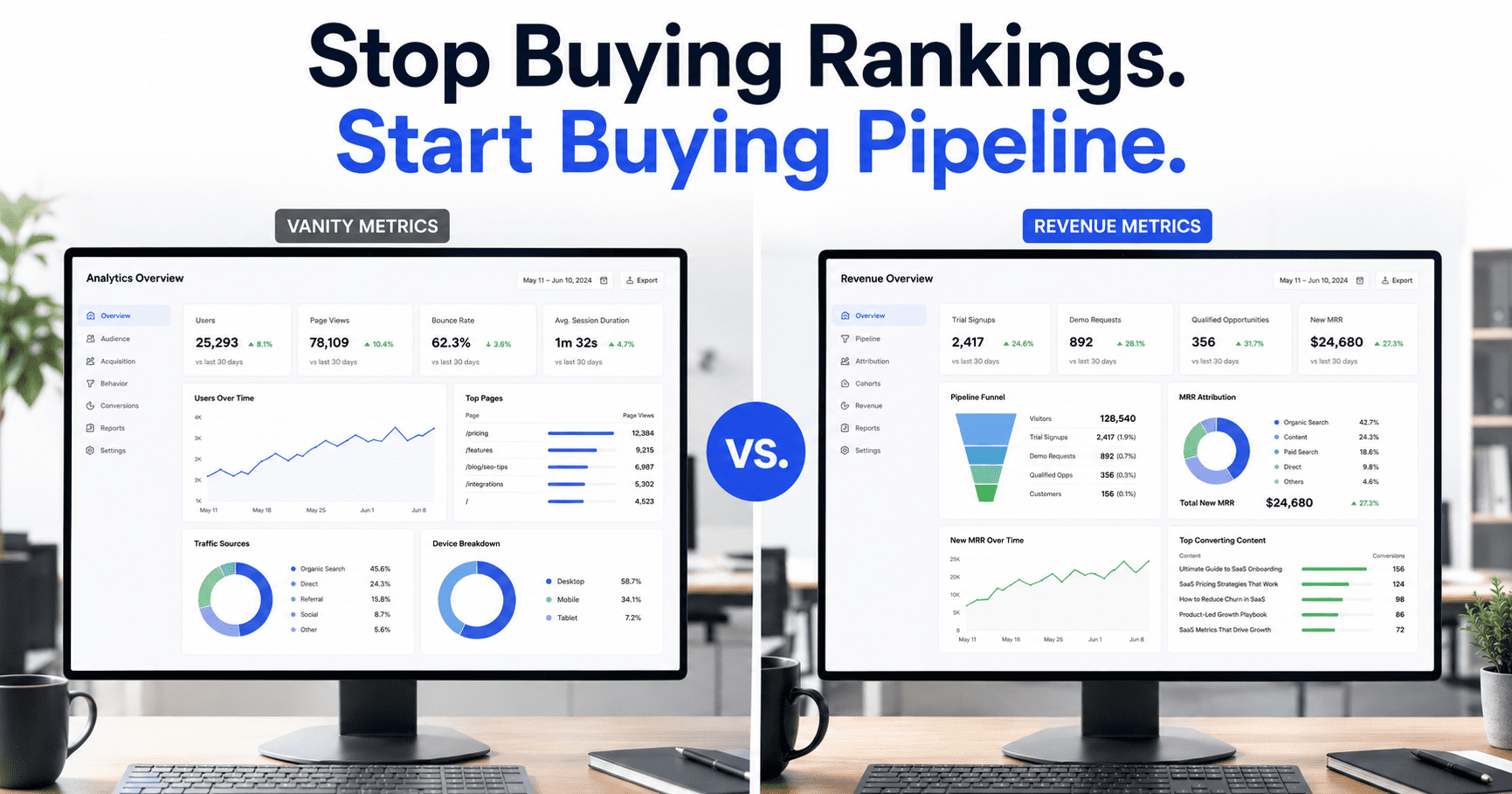
Your SEO agency sends you a report. Organic traffic is up 47%. Your CMO wants to know why demo requests are down 12%. This is the SaaS SEO agency problem. Most agencies sell you what they know how to deliver: rankings and traffic. The experience will be very different when you engage with the best Saas SEO agencies. What you actually need is pipeline attribution and trial velocity. According to industry research on SaaS SEO performance, organic search drives over 50% of trackable website traffic, but most SaaS companies can’t connect that traffic to closed revenue.
This guide walks you through how to evaluate SaaS SEO agencies, what separates the best from the rest, and the exact questions to ask before you sign a $5K-$15K monthly retainer. We’ll cover why traditional SEO metrics fail for subscription businesses, which agencies actually understand SaaS economics, and how to structure an engagement that ties organic performance to MRR growth.
Why Most SEO Agencies Can’t Actually Help SaaS Companies
Here’s what breaks when a traditional SEO agency tries to scale a SaaS product: they optimize for the wrong conversion event.
A local service business wants phone calls. An e-commerce site wants purchases. A SaaS company needs qualified trial signups that convert to paying customers at a profitable CAC. These are not the same thing.
Traditional agencies build content around high-volume keywords because that’s how you maximize traffic. SaaS agencies build content around buyer intent keywords because that’s how you maximize trial quality. The first strategy gets you 50,000 monthly visitors who bounce. The second gets you 5,000 visitors who book demos.
The second problem is sales cycle complexity. According to research from top B2B SaaS agencies, 60% of B2B SaaS purchases involve multiple stakeholders and three-month evaluation cycles. Your SEO content services need to serve the developer testing your product, the director evaluating alternatives, and the VP signing the contract. Traditional agencies don’t build for buying committees. They build for individual searchers.
The third gap is attribution. SaaS SEO agencies connect content to the pipeline through multi-touch attribution, CRM integration, and cohort analysis. Traditional agencies show you Google Analytics dashboards. When your CFO asks what organic search contributed to this quarter’s bookings, one agency has an answer. The other doesn’t.
What The Best SaaS SEO Agencies Actually Do Differently
The agencies that understand SaaS don’t start with keyword research. They start with your ideal customer profile and reverse-engineer the search behavior.
They map content to funnel stages. Bottom-of-funnel comparison pages that capture people actively evaluating solutions. Mid-funnel use case guides that address specific job-to-be-done searches. Top-of-funnel thought leadership that builds authority with enterprise buyers who won’t interact with sales for months.
They track the right metrics. Not rankings. Not traffic. Trial signups attributed to organic search, time-to-value for users who came through content, expansion MRR from customers who engaged with product education articles, and churn rates for users who completed onboarding guides versus those who didn’t.
They price for outcomes. The best SaaS SEO agencies don’t charge by the hour or by the deliverable. They charge retainers tied to pipeline contribution. If you’re paying $10K monthly and organic search drives 15 qualified trials worth $3K each in LTV, the math justifies itself. If you’re paying $10K monthly for 20 blog posts and 50,000 page views, you’re getting scammed.
They understand product-led growth. In 2026, the best SaaS SEO isn’t just blog content. It’s comparison pages that rank for ‘[Competitor] alternatives,’ technical documentation that shows up when developers search implementation questions, integration guides that appear when users look for workflow automation, and case studies that surface during due diligence.
How To Evaluate SaaS SEO Agencies (The Questions That Expose Pretenders)
Ask these five questions before you sign anything. The answers will tell you if you’re talking to a real SaaS SEO agency or a content shop with ‘SaaS’ on their homepage.
Question 1: How do you connect organic search to closed revenue?
The right answer involves UTM tagging, CRM integration, cohort tracking, and multi-touch attribution models. If they say ‘Google Analytics goal tracking,’ walk away. You need an agency that can show which content pieces influenced trial signups two months before conversion, not just which pages got traffic last week.
Question 2: What’s your content prioritization framework?
The right answer starts with bottom-of-funnel keywords, not traffic volume. They should explain why comparison content converts 2-3x higher than educational guides, how they identify buying-intent search terms, and why they build product-led content before thought leadership. If they pitch ‘comprehensive guides on industry trends,’ they don’t understand SaaS.
Question 3: Show me a SaaS client where organic search drives 20%+ of trials
Not traffic growth. Trial attribution. The best agencies will show you screenshots from client dashboards proving organic search contributed X trials in the last 90 days with Y% trial-to-paid conversion. If they can’t produce this, they’ve never actually scaled a SaaS product through SEO.
Question 4: How do you handle content for multiple buyer personas?
B2B SaaS sells to developers, managers, and executives at the same time. The agency should explain how they create separate content tracks for technical users versus economic buyers, how they structure internal linking between persona-specific articles, and why some content targets product adoption while other pieces target procurement.
Question 5: What’s your timeline to meaningful pipeline contribution?
The honest answer is 6-9 months for measurable trial attribution from organic search. Anyone promising results in 90 days is lying or planning to buy links from spam networks. SEO compounds. Months 1-3 is foundation work. Months 4-6 is when rankings start moving. Months 7-12 is when you see pipeline impact. Agencies that understand this will tell you upfront.
What You Should Actually Pay For SaaS SEO (And What You Get At Each Price Point)
SaaS SEO agency pricing ranges from $3,000 to $25,000 monthly, depending on scope, stage, and whether you need traditional search visibility, AI search optimization, or both.
At $3,000- $5,000 per month, you’re getting foundational work. Technical SEO audits, keyword research focused on bottom-of-funnel terms, 4-6 content pieces per month, and basic link building. This works for early-stage SaaS companies with under $2M in ARR that need to establish an organic presence without burning cash. Expect 8-12 months before you see meaningful trial attribution.
At $6,000-$10,000 monthly, you’re getting execution velocity. 8-12 content pieces monthly, comparison page campaigns, programmatic SEO for long-tail keywords, digital PR for authority building, and proper attribution tracking through your CRM. This tier makes sense for growth-stage companies ($5M-$20M ARR) where organic search should be driving 15-25% of the pipeline.
At $12,000-$25,000 monthly, you’re getting enterprise-scale programs. Multi-market SEO, AI search optimization, technical content for developer audiences, executive thought leadership, and dedicated account teams. Only worth it for SaaS companies above $50M ARR where a 10% lift in organic trial volume translates to millions in ARR.
The mistake most SaaS companies make is picking the cheapest option that claims to do SEO. A $2,000/month agency will produce content. It just won’t be the right content, targeted at the right keywords, structured to convert the right users. You’ll spend 12 months and $24K learning this lesson. Or you can invest $8K monthly with an agency that understands SaaS economics and see results in half the time.
The Biggest Red Flags When Evaluating SaaS SEO Agencies
Here’s what to avoid. If an agency does any of these things, they’re either incompetent or dishonest. Either way, don’t hire them.
They guarantee rankings. No legitimate agency guarantees page one rankings because nobody controls Google’s algorithm. What they can guarantee is execution quality, content velocity, and transparent reporting. Promises about specific ranking positions are sales theater.
They pitch high-volume keywords first. ‘Project management software’ gets 50,000 searches monthly but converts nobody because the intent is too broad. ‘How to track sprint velocity in Jira’ gets 800 searches monthly but every visitor has a specific problem your product solves. Agencies that optimize for traffic volume don’t understand SaaS buyer behavior.
They won’t share their link-building sources. If an agency is secretive about where they build links, they’re buying spam links from PBNs that will get your site penalized. The best agencies build links through digital PR, guest posts on industry publications, and partnerships with complementary SaaS tools. They’ll show you their outreach templates and placement targets because they have nothing to hide.
They don’t ask about your product. A good SaaS SEO agency spends the first call asking about your ICP, pricing model, trial-to-paid conversion rates, and competitive differentiation. An agency that pitches a templated SEO package before understanding your business is selling commoditized services, not SaaS expertise.
They charge per piece of content. This creates the wrong incentive. You want an agency focused on pipeline contribution, not content volume. Retainer pricing aligns incentives because the agency succeeds when your trial signups increase, not when they publish 20 mediocre blog posts.
Frequently Asked Questions
How long does it take to see results from a SaaS SEO agency?
Expect 6-9 months for meaningful trial attribution from organic search. The first 90 days are foundation work including technical audits, keyword strategy, and initial content production. Months 4-6 show ranking improvements. Months 7-12 deliver measurable pipeline contribution. Anyone promising results faster is either targeting low-competition keywords with minimal business value or planning tactics that risk penalties.
Should I hire a SaaS SEO agency or build an in-house team?
Agencies deliver more capability per dollar until you hit $50M ARR or 100+ employees. Below that threshold, building an in-house SEO team costs $150K-$250K annually for one strategist and one writer, versus $60K-$120K annually for an agency that brings specialized expertise, tool access, and faster execution velocity. The hybrid model works best: agency for strategy and link building, in-house for product content and ongoing optimization.
What’s the ROI of SaaS SEO compared to paid acquisition?
SEO has a 7-month median breakeven point according to B2B content marketing benchmarks. After that inflection point, organic search typically delivers 3-5x ROI compared to paid channels because the content compounds. If your paid CAC per trial is $4,000 and an SEO program at $8,000 monthly produces 10 trials monthly, your blended organic CAC is $800. The economics favor SEO for any SaaS company with enough runway to reach month seven.
Do SaaS SEO agencies work with early-stage startups?
The best agencies have tier structures. Early-stage packages start around $3,000-$5,000 monthly with focused scope on bottom-of-funnel content and technical foundations. Growth-stage engagements run $6,000-$12,000 monthly with broader content coverage. Enterprise programs exceed $15,000 monthly. Look for agencies that explicitly serve your ARR range rather than trying to squeeze into an enterprise-focused shop.
What metrics should I track to measure SaaS SEO performance?
Track trial signups attributed to organic search in the last 30 days, trial-to-paid conversion rate for organic users versus other channels, time-to-value for customers who came through content, expansion MRR from users who engaged with product education articles, and CAC payback period for organic versus paid acquisition. Rankings and traffic are leading indicators but pipeline contribution is the only metric your CFO cares about.
Can a SaaS SEO agency help with product-led growth?
Yes, if they understand PLG mechanics. Product-led SEO targets users searching for implementation help, integration guides, and feature-specific solutions. The content serves both acquisition and activation. For example, a detailed guide on ‘how to automate Slack notifications from customer support tickets’ attracts users researching that workflow while teaching them your product’s capabilities. The best PLG-focused agencies build content that reduces time-to-value, not just top-of-funnel awareness.
What’s the difference between SaaS SEO and regular B2B SEO?
SaaS SEO prioritizes trial velocity and expansion revenue, while traditional B2B SEO optimizes for lead volume. SaaS requires content for the entire customer lifecycle, including onboarding, feature adoption, and retention. The sales cycle involves multiple stakeholders, so content needs to serve technical evaluators and economic buyers simultaneously. SaaS metrics like MRR, churn, and LTV dictate content strategy, whereas B2B service companies optimize for deal size and sales cycle length.
Most SaaS companies hire SEO agencies based on the wrong criteria. They pick whoever has the best sales deck, the most case studies, or the lowest retainer. Then they spend 12 months watching organic traffic climb while trial signups stay flat.
The best AI SEO agencies don’t sell you rankings. They sell you pipeline contribution tied to multi-touch attribution and cohort analysis. They understand your customer acquisition economics, your product-market fit challenges, and why a trial signup from organic search converts differently than one from paid ads. They build content that serves buying committees across three-month evaluation cycles, not individual searchers looking for quick answers.
Before you sign a retainer, ask the five questions from this guide. Demand proof of trial attribution, not traffic growth. Get clarity on their content prioritization framework. Make sure they can explain how organic search will contribute to your next board deck, not just your marketing dashboard.
QualiPulse works with B2B SaaS companies that need SEO connected to the pipeline, not vanity metrics. We’ll audit your current organic performance, identify the highest-impact content gaps in your funnel, and show you exactly how SEO should contribute to trial velocity and expansion MRR. Most clients see measurable trial attribution within 6 months because we start with bottom-of-funnel content, not thought leadership. Book your free 30-minute SaaS SEO strategy audit by clicking here.