Most SaaS founders treat SEO for SaaS startups as a background task. They post a few articles, install a plugin, and wait. Six months later, nothing has moved. The budget shifts to paid ads that get more expensive every quarter, and organic search ends up filed under “things we will get to eventually.”
Here is the problem with that thinking: organic search is the single largest acquisition channel for established SaaS companies. HubSpot generates over 10 million organic visits per month. Zapier built 3 million monthly visitors through programmatic integration pages. Canva reaches 120 million visitors on the back of template-driven content. None of that happened by accident.
The data is unambiguous. Research from First Page Sage puts the ROI of SEO for SaaS startups at 702%. A 2025 analysis by Powered by Search found that companies with strong SEO programs generate twice the revenue from organic search as from social media. And organic traffic accounts for 26.4% of visits to the largest 50 SaaS companies, making it the biggest source of new visitors across the board.
This article gives you the system behind those results. Not theory. Not a generic content calendar template. A practical, sequenced playbook built specifically for the way SaaS buyers search, research, and decide.
1. Why SEO for SaaS Startups Is Different From Regular SEO
SEO fundamentals are the same across industries. Keywords, backlinks, technical health, and content quality — none of that changes because you sell software. What changes is how you apply those fundamentals to the specific buying behavior, funnel dynamics, and content requirements of SaaS.
1.1 The SaaS Buyer Does Not Impulse-Purchase
Someone buying a pair of sneakers decides in minutes. A SaaS buyer evaluating a project management tool for their 50-person team might take 3 to 6 months. They search, read, compare, demo, negotiate, and then decide. That journey creates dozens of search touchpoints, and your content either shows up at those moments or it does not.
This means your SEO strategy cannot be a single article and a homepage. It has to map the entire decision journey, from the first time someone searches “how to manage a remote engineering team” all the way to “Asana vs Monday pricing for enterprise.”
1.2 The Business Model Creates Unique Content Opportunities
SaaS companies have features, integrations, use cases, templates, and customer categories that each represent a keyword cluster. A CRM tool is not just targeting “CRM software” — it is targeting “CRM for real estate agents”, “CRM with email automation”, “HubSpot alternative for small business”, and hundreds of other specific queries.
This is where the opportunity is. Most SaaS startups target two or three broad terms and leave hundreds of specific, convertible searches on the table.
1.3 Retention Matters as Much as Acquisition
When a SaaS customer churns, the lifetime value equation breaks. Your SEO content should not just acquire customers — it should help existing ones succeed. Knowledge bases, onboarding guides, and use case documentation that rank in search also serve customers who are already paying. That dual function makes content investment go further.
2. Keyword Strategy by Funnel Stage
The biggest keyword mistake SaaS startups make is targeting high-volume, low-intent terms they cannot rank for while ignoring specific, convertible searches they could rank for within 90 days. Funnel-stage thinking fixes this.
2.1 Top of Funnel (TOFU): Build Awareness and Authority
TOFU keywords are informational. The searcher has a problem, but is not yet looking for software. They want to understand the problem better.
Examples: “how to reduce employee churn”, “what is MRR in SaaS,”, “remote team communication best practices.”
These searches have high volume and low buying intent. They build brand exposure and earn backlinks from people citing your educational content. TOFU alone will not drive revenue, but it is the foundation of topical authority that makes your other pages rank.
2.2 Middle of Funnel (MOFU): Capture Consideration
MOFU searchers know their problem and are now researching solutions. They are comparing approaches, reading case studies, and forming opinions on what type of tool might help.
Examples: “best project management tools for engineering teams”, “how to improve SaaS onboarding”, “employee engagement software comparison.”
This is where your comparison pages, feature breakdowns, and use case content live. A searcher at this stage is much closer to a trial than a TOFU reader.
2.3 Bottom of Funnel (BOFU): Close the Intent Gap
BOFU searches have high purchase intent. The person is ready to evaluate specific tools and make a decision.
Examples: “Intercom vs Zendesk for B2B SaaS”, “[your product] pricing”, “[your product] alternatives”, “[competitor] review 2026”
These pages convert at the highest rate. Rank here and you are reaching people who are one decision away from becoming a customer. Many SaaS startups ignore this category entirely, leaving conversion-ready searches to competitors. Our content engine service is built around prioritizing BOFU before TOFU, because that is where the compounding financial return starts.
| Funnel Stage | Search Intent | Content Type | Primary Goal |
| TOFU | Informational | How-to guides, definitions, best practice posts | Brand awareness, backlinks, and topical authority |
| MOFU | Consideration | Comparisons, feature explainers, use case pages | Lead generation, trial sign-ups |
| BOFU | Decision | Alternative pages, pricing pages, reviews, demos | Direct conversions, revenue |
2.4 The Long-Tail Advantage for Early-Stage SaaS
If your domain authority is low, you cannot compete for “project management software” against Asana and Monday. But you can rank for “project management software for creative agencies under 20 people.” According to the SaaS SEO Playbook, early-stage SaaS startups should prioritize keywords with a difficulty score under 20. Long-tail terms convert better because the searcher is more specific about what they need.
Target specificity first. Broaden as your authority grows.
3. Technical SEO: The Foundation You Cannot Skip
You can write the best content in your category and still rank nowhere if the technical foundation is broken. Search engines need to find, crawl, understand, and trust your site before they will rank it. For SaaS products with complex JavaScript-rendered dashboards, this is especially important.
3.1 Core Web Vitals
Google’s Core Web Vitals measure the page experience your users get: how fast pages load (LCP), how stable they are during loading (CLS), and how quickly they respond to input (INP). Research from Search Engine Journal shows that implementing structured data and passing Core Web Vitals can increase click-through rates by up to 30%. For SaaS products with complex front ends, use lazy loading and code splitting to hit the sub-2-second load time benchmark.
3.2 Crawlability and Indexation
Search engines cannot rank what they cannot find. Three common SaaS crawl problems:
- JavaScript-heavy pages: If your marketing pages are client-side rendered, Googlebot may not parse the content correctly. Server-side rendering (SSR) or static generation for public pages eliminates this risk.
- Accidental noindex tags: Staging environments sometimes carry noindex tags into production. Audit every canonical tag and robots.txt directive before launching.
- Duplicate content: Filter parameters, pagination, and URL variants create duplicate pages that dilute ranking signals. Canonical tags tell search engines which version to rank.
3.3 Schema Markup
Structured data tells search engines what your content is about — software, pricing, reviews, FAQs — in a language they parse directly. Sentari’s 2026 SEO research found that SaaS companies using schema markup are 35% more likely to appear in AI-driven summaries. That advantage only grows as AI Overviews take more real estate in search results.
3.4 Site Architecture and Internal Linking
How your pages link to each other tells search engines which content is most important and how topics relate. SaaS companies that build clear topic clusters — a pillar page on a core topic linking to supporting posts — rank faster and hold rankings longer than sites with scattered, disconnected content.
Every internal link should serve two purposes: guide the reader to the next useful page, and pass authority to where you want it. Link educational blog content to product pages. Link comparison content to pricing. Make your case studies discoverable from problem-focused posts. The architecture is the strategy.
| Technical SEO Quick-Check
• Site loads under 2 seconds on mobile (test with Google PageSpeed Insights) • All marketing pages are server-side rendered, not JavaScript-only • No unintentional noindex tags on pages you want ranked • XML sitemap submitted to Google Search Console and Bing Webmaster Tools • Schema markup in place for SoftwareApplication, FAQ, and Review types • Canonical tags resolve all duplicate URL variants • Internal links connect blog content to product and pricing pages |
4. Content Architecture That Compounds
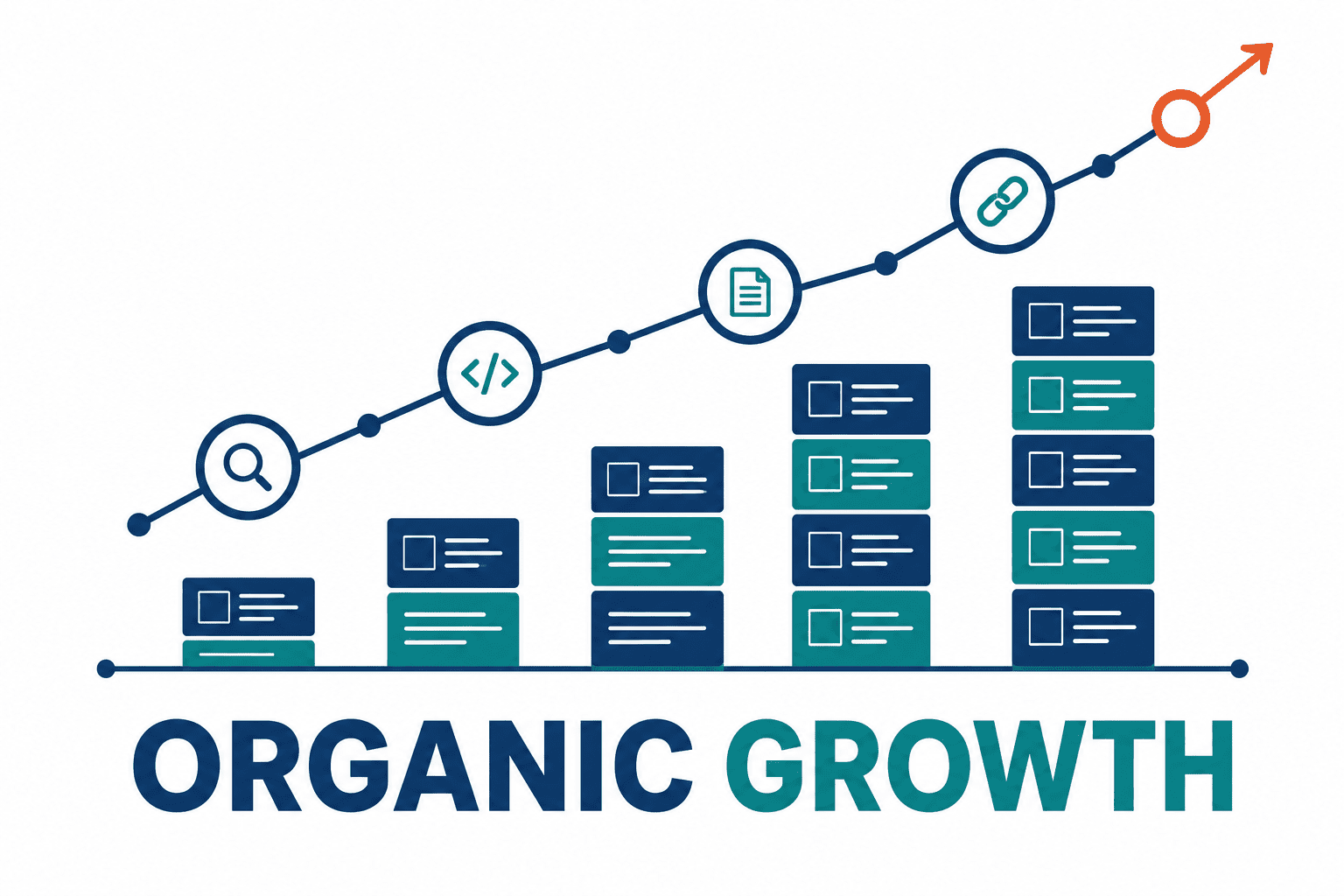
SaaS content works on a compound interest model. The first 20 articles barely move anything. By month 9 or 10, the body of work starts reinforcing itself — each new article adds context to existing ones, topical authority deepens, and rankings lift across the whole cluster. But only if the architecture is right from the start.
4.1 The Hub-and-Spoke Model
Pick a core topic — your product category or the primary problem you solve. Write one comprehensive pillar page that covers that topic broadly. Then write a series of supporting posts that each go deep on one specific aspect of the topic and link back to the pillar.
A HR software company might have a pillar on “employee performance management” with spokes covering “how to write performance reviews”, “OKR frameworks for remote teams”, “performance improvement plan templates”, and “continuous feedback software comparison.” Each spoke reinforces the pillar. The pillar amplifies the spokes.
4.2 Content Types That Drive SaaS Rankings
Not all content formats rank equally well for SaaS. The highest-performing types, based on consistent evidence from high-growth SaaS companies:
- Comparison and alternatives pages: “[Competitor] alternatives” and “[Tool A] vs [Tool B]” pages capture searchers at the moment of decision. These are the highest-converting pages in most SaaS content programs.
- Use case pages: “[Your product] for [specific role/industry]” pages target segments your homepage cannot serve. A time-tracking tool has different value propositions for lawyers, agencies, and freelancers — each deserves its own page.
- Integration pages: “[Your product] + [popular tool] integration” pages capture searchers looking for a connected workflow. Zapier built most of its organic traffic this way.
- Original research and data: Content backed by original data earns backlinks passively for years. A survey of 300 SaaS companies on onboarding benchmarks becomes a citation source across the industry.
- Glossary and definition pages: “What is MRR”, “churn rate definition”, “SaaS ARR explained” — these definitional searches are high-volume and easy to rank for with domain authority. They also earn links from writers citing your definitions.
4.3 Publishing Frequency That Actually Works
Orbit Media’s 2025 study found that about half of marketers publish 2-4 new articles per month, and 37% of bloggers who report strong results post multiple times per week. For early-stage SaaS with lean teams, two high-quality articles per month targeting keywords with difficulty under 20 is a better bet than six thin articles chasing broad terms.
Depth beats volume. One article that fully answers a specific question will outrank five articles that partially address it.
| Content Priority Order for SaaS Startups
• 1. BOFU: Competitor alternative pages and direct comparison pages (convert fastest) • 2. BOFU: Use case pages for your primary customer segments • 3. MOFU: Category comparison and feature breakdown guides • 4. TOFU: Educational guides on the core problems your product solves • 5. Programmatic: Integration pages, template pages, location/industry pages at scale |
5. Link Building for SaaS: Quality Over Everything
Backlinks are still one of the strongest ranking signals search engines use. One link from a respected SaaS publication with genuine editorial standards is worth more than 50 links from low-quality directories.
5.1 Create Assets Worth Linking To
The most durable link-building strategy for SaaS is not outreach — it is publishing content that earns links passively because it is the best resource on a topic.
- Original data reports: Survey your customer base. Analyze anonymized product data. Publish findings with methodology and charts. Researchers, bloggers, and journalists cite data for years.
- Free tools and calculators: A CAC calculator, an MRR growth model, a churn impact estimator — tools that solve a problem people search for become link magnets because every writer covering that topic wants to give their reader something actionable.
- Comprehensive guides: If your guide is the definitive resource on a topic, writers who cover that topic will link to it rather than write their own version. Own the topic.
5.2 Guest Posting Done Right
Guest posting earns links and builds authority when done with real editorial value. The mistake most SaaS marketers make is pitching generic topics to high-DA sites that have no ICP overlap. The right approach:
- Match publication to ICP: If you sell to DevOps teams, pitch to engineering publications, not general marketing blogs.
- Lead with the problem: The best pitches open with a specific problem the publication’s audience has, and position the article as the solution — not as a way to get a link.
- Give three headline options: Not one vague topic. Three tight, specific headlines that show you have already thought.
5.3 Digital PR
Getting mentioned in industry coverage earns high-DA links that outreach cannot replicate. For SaaS startups, three PR angles work consistently:
- Original data and research that journalists can cite in their own coverage
- Founder commentary on industry trends through tools like HARO and Qwoted
- Product milestones with a story — funding, major customers, category creation
5.4 Directories and Review Platforms to improve SEO for SaaS Startups
Listings on G2, Capterra, and Product Hunt are table stakes for SaaS SEO. These platforms have a domain authority above 85 and their category pages rank for exactly the comparison searches your buyers make. Reviews on these platforms also influence the trust signals that affect your own site’s ranking.
| Link Building Channel | Time to Results | Difficulty | Link Quality |
| Original data reports | 3-12 months (passive) | High (create once) | Very High |
| Guest posting | 1-3 months per campaign | Medium | High (if targeted) |
| Digital PR / HARO | 1-4 weeks per hit | Medium | Very High |
| Review platforms (G2, Capterra) | Immediate | Low | High (DA 85+) |
| Competitor backlink gaps | 2-6 months | Medium | High |
| Integration partner co-mentions | 1-3 months | Low | High (relevant) |
6. Measuring SEO Performance in SaaS
Measuring SEO without tying it to revenue is how you end up celebrating traffic spikes that do not convert. SaaS SEO measurement should start with business outcomes and work backward to traffic signals.
6.1 The Metrics That Actually Matter
- Organic trials and demos: How many free trial sign-ups or demo requests came from organic search? This is the primary conversion metric, not traffic volume.
- Keyword rankings on BOFU pages: Track the ranking position of your comparison, alternative, and use case pages. Movement here has direct revenue implications.
- Organic-attributed pipeline: With UTM tracking and a CRM integration, you can see how much closed revenue traces back to an organic search touchpoint. This is the number that wins the budget.
- Referring domains growth: Total backlinks fluctuate. Referring domains (unique sites linking to you) is a more stable signal of link equity accumulation. Aim for 10-20% month-over-month growth in early stages.
- Indexed pages with impressions: In Google Search Console, track how many of your pages are appearing in search results and for which queries. Pages with impressions but low click-through rates are candidates for title and meta description optimization.
6.2 Tools Worth Using in SEO for SaaS Startups
Google Search Console — Free and authoritative. The closest thing to ground truth for how Google sees your site.
Ahrefs — The most complete backlink database and keyword explorer. Essential for competitor gap analysis.
Semrush — Strong for position tracking, content audit, and all-in-one SEO workflow management.
Screaming Frog — Technical crawler for finding broken links, duplicate content, and crawl errors at the page level.
6.3 The Realistic Timeline
One of the most important things to communicate internally: SEO does not produce results in week three. The SaaS SEO Playbook research shows that well-executed programs deliver 4-6x ROI over 24 months, with the first 6 months showing minimal returns as content indexes and authority accumulate.
Month 1-2: Technical audit, keyword mapping, content strategy. Month 3-4: Publishing begins, early long-tail rankings appear. Month 5-6: Measurable traffic growth. Months 7-12: The compound effect. Month 12-24: BOFU content converts, organic becomes a reliable pipeline channel.
Leadership teams that understand this curve fund the program through the early quiet period and reap the compound returns. Those that expect results in 60 days reallocate budget to paid channels and forfeit the compounding advantage entirely.
7. The AI Search Shift and What It Means for SaaS SEO
The search landscape is shifting. A 2025 study across SaaS marketers found that over 60% reported AI-driven search results already affecting their organic traffic patterns. Around 30% of SaaS traffic loss in early 2025 is attributed to position-zero displacement by AI answers. This is not a future concern — it is a present one.
7.1 Optimize for AI Citation, Not Just Rankings
When ChatGPT, Perplexity, or Google’s AI Overviews answer a query, they cite sources. The goal for SaaS SEO in 2026 is not just to rank in the blue links — it is to be cited by AI systems as an authoritative source. Data from the same study shows SaaS companies using schema markup and FAQ structures are 35% more likely to appear in AI-driven summaries.
To optimize for AI citation: use structured data. Write content with clear, direct answers to specific questions. Publish original research that AI systems cite as a data source. Build authority signals that make your site a credible reference — not just a ranked page.
7.2 What Does Not Change SEO for SaaS startups
Despite the shift, the fundamentals of seo for saas startups do not change. High-quality content that genuinely helps readers still earns links. Technical health still determines whether Google can index your pages. Domain authority still amplifies every piece of content you publish. The tactics evolve; the principles hold.
The SaaS companies that treat SEO as a foundation rather than a campaign will adapt to the AI search shift and keep compounding. Those treating it as a quick-win channel will scramble every time the algorithm changes. If you want a team that understands both the fundamentals and where search is heading, let’s talk.
8. The 90-Day Action Plan to improve SEO for SaaS Startups
Here is how to make this operational without trying to do everything at once.
Month 1: Foundations
- Run a technical audit using Google Search Console and Screaming Frog. Prioritize crawl errors, Core Web Vitals failures, and any accidental noindex tags
- Map keywords by funnel stage for your top 5 product use cases
- Identify the 3 BOFU pages you should publish first: one competitor alternative page, one direct comparison, one use case page
- Claim and optimize profiles on G2, Capterra, and Product Hunt
- Set up conversion tracking to attribute trials and demos to organic search in GA4
Month 2: Build
- Publish the 3 BOFU pages identified in month 1 with full on-page SEO: title tags, meta descriptions, schema markup, internal links to pricing
- Start your first content cluster: one pillar page plus 3-4 supporting posts targeting TOFU and MOFU keywords
- Launch your first link-building outreach campaign targeting 15-20 relevant publications
- Submit your XML sitemap to Bing Webmaster Tools if not already done
- Draft your first original data piece (a survey, a benchmark analysis, or a proprietary data report)
Month 3: Scale
- Analyze Search Console data to see which pages are getting impressions but low click-through rates — rewrite title tags for those pages first
- Publish your original research piece with a PR outreach campaign to 10 relevant journalists
- Start your second content cluster in a different topic area
- Review which BOFU pages are ranking in positions 5-20 and build targeted links to those specific pages
- Set up monthly reporting: organic trials, keyword rankings for BOFU pages, referring domains growth
Conclusion
SEO for SaaS startups is not a content calendar. It is a compounding growth system that requires the right sequencing: technical foundation first, BOFU keyword targeting second, content architecture third, link building throughout, and consistent measurement from day one.
The startups that win with SEO are the ones that start before they think they are ready, prioritize specificity over volume, and treat organic search as a long-term asset rather than a short-term tactic. The returns compound. The competitors who wait are funding your advantage.
If you want a practitioner-led content team that can execute this system for your SaaS company, QualiPulse builds content engines for software companies. We also run LinkedIn visibility programs that amplify the organic reach of your content.