
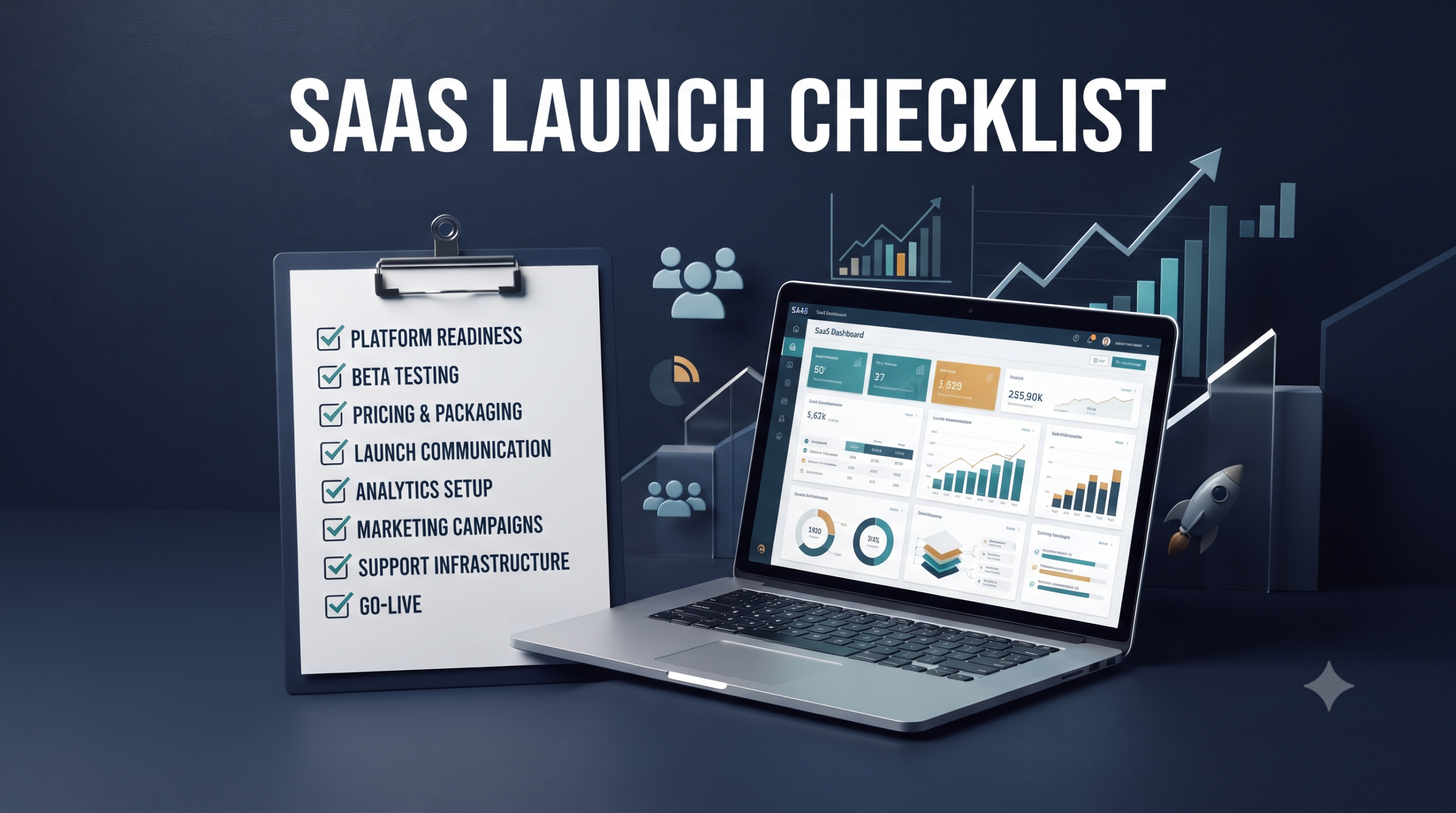
A SaaS launch checklist should answer one question: are you ready to ship software, or are you ready to acquire customers? For years, I have been reviewing software products and delivery teams, and I would test launch readiness in five areas: product experience, discoverability, measurement, authority, and customer evidence.
The mistake is to think that launch day is the end. The first 30 days are part of the launch. Establish a Day 0 baseline for indexing, search visibility, signups, activation, and paid conversion, and then measure what changes. The 10 checks in this guide are based on that principle: launch, measure, learn, and correct fast.
SaaS Launch Checklist Basics
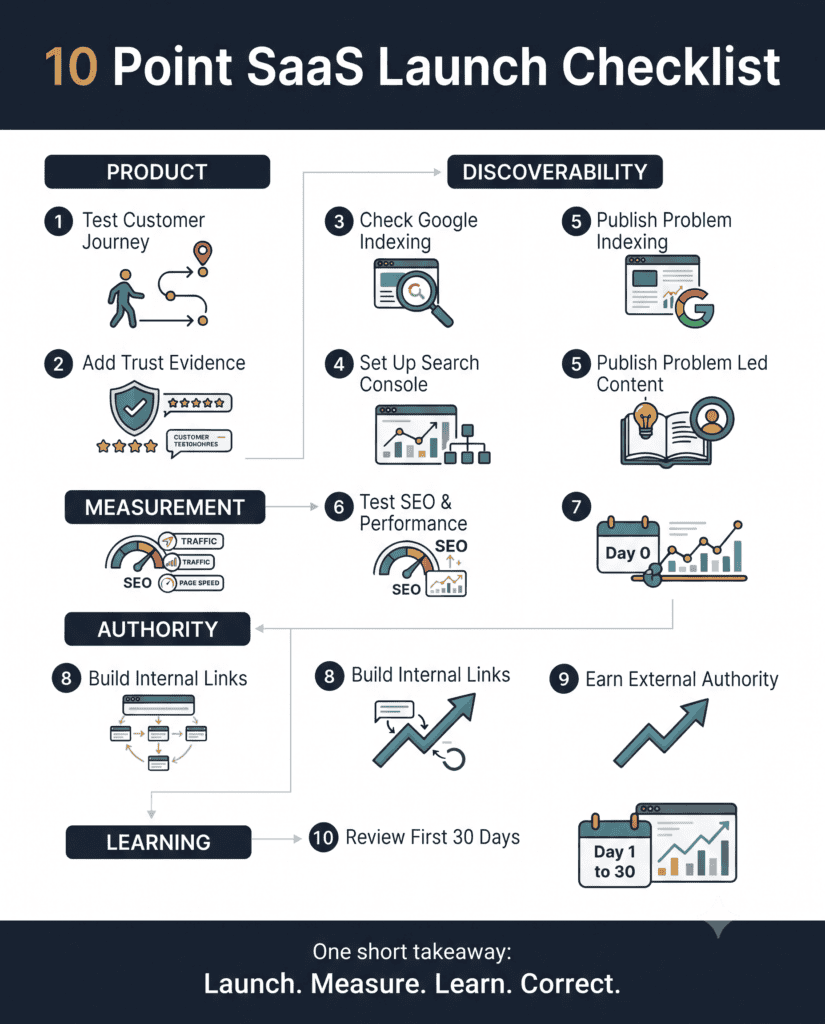
- Pre-launch test the full customer journey
- Ensure Google can find and index the right pages
- Set up Search Console and submit sitemap
- Technical SEO, speed & mobile experience audits
- Set a baseline for Day 0 measurement
- Build content on purchase intent and customer pain points
- Create internal links around relevant topic clusters
- Build external authority through credible sites and partners
- Include testimonials, reviews, and proof
- Conduct a formal 30-day post-launch review
1. Test the full customer journey before launching
Before you even think about acquisition, make sure the product is worth the traffic. Start a brand-new account and go through the journey without any internal shortcuts.
- Go to the homepage
- Comprehend the proposition
- Sign Up
- Verify your email
- Finish onboarding
- Utilize the core feature
- Pay or upgrade
- Cancel
- Reach out to support
The question is simple: can a new user get the first meaningful outcome without asking your team for help? If not, more traffic could just lead to more abandonment.QualiPulse helps teams that want to have an independent view of product readiness before scale magnifies the weak spots, focusing on product value, quality, and customer experience.
2. Ensure Google Finds and Indexes the Right Pages
A live page is not necessarily a discoverable page. See if search engines can view your homepage, pricing page, product pages, key articles, and use cases. The important difference is discovery vs. indexing. Even if a search engine finds a URL, it may not index it.
Therefore, launch teams need to verify both crawlability and index status, and not assume that publication = visibility. In its Search documentation, Google explains how it crawls and indexes.
3. Configure Search Console and Submit Your Sitemap
Search Console should be set up on launch, not 3 months after. Verify your domain, submit the sitemap, and check your most important URLs.
Use the Pages report to find exclusions, crawl issues, and pages found but not indexed by Google. Search engines use the sitemap to find your preferred URLs, but it does not guarantee that every page you submit will be included in the index.
It’s worth following Google’s official advice on sitemaps and asking for a direct recrawl.
4. Technical SEO, Speed and Mobile Experience
Do a technical crawl before the promotion kicks off. Check for broken links, missing titles, duplicate metadata, wrong canonical tags, redirect chains, orphan pages and sitemap issues. Then test the site on real mobile devices. Pricing tables, sign-up forms, cookie banners, and navigation often behave differently on phones than they do during desktop reviews.
Don’t try to get a perfect audit score. Prioritize issues based on business impact. A broken pricing page is more important than a minor metadata warning on a low-traffic article. For performance guidance, refer to Google’s Core Web Vitals documentation
5. Establish a Day 0 Measurement Baseline
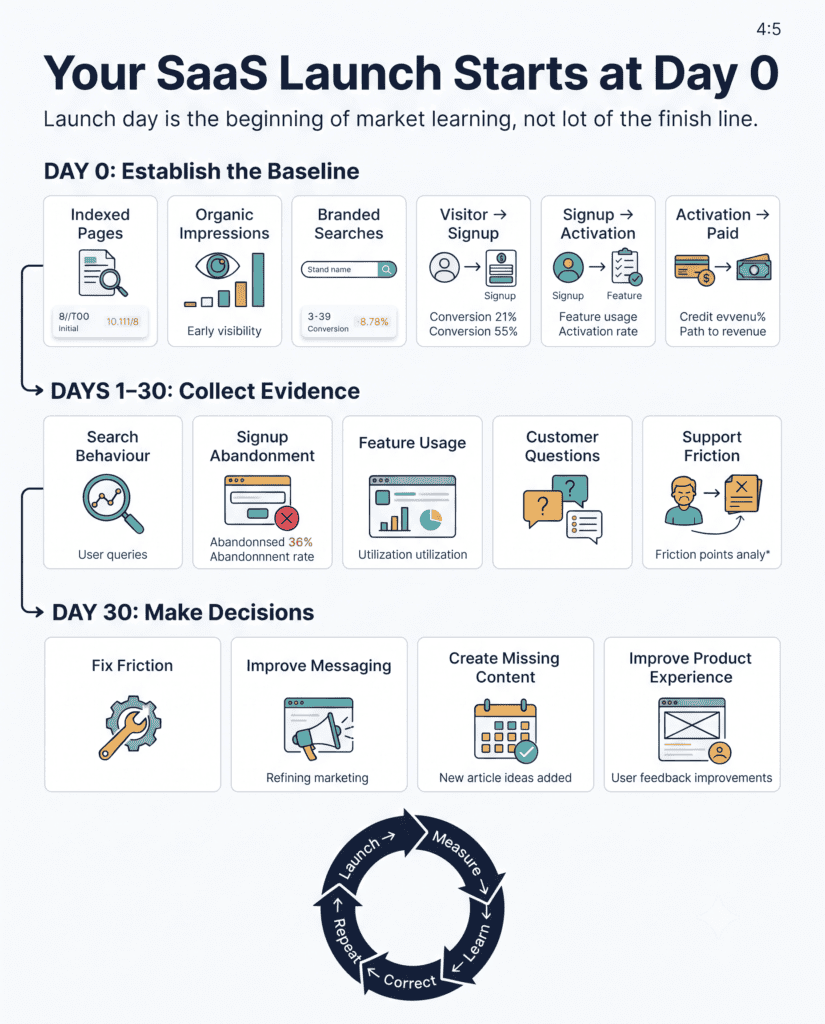
This is one of the most useful launch disciplines, and one of the least discussed. On the day of the site launch, record your baseline.
- Pages indexed
- Organic reach
- Brand name searches
- Visitors sign-up ratio
- Signup/Activation ratio
- Conversion to paid activation
This isn’t about proving you’ve arrived in week one. The goal is to produce a benchmark. 30 days later, you see what has changed, and you connect the movement to the actions you took.
Without a baseline, teams celebrate growth without knowing if it was the result of search, paid acquisition, partner activity, product changes, or pure launch noise.
6. Create Content Around Customer Pain Points and Buying Intent
1 blog post is not a content plan. Your first content set should tackle the questions buyers ask before they even think about a product like yours.A strong starting set usually includes problem pages, use case pages, comparison pages, integration pages and a few high intent articles. The best topics are close to the buying decision.
For example, a platform for API testing will benefit more from the content on how to reduce regression time, test data bottlenecks and endpoint coverage than another general article on what API testing is.
7. Create Internal Links Around Meaningful Topic Clusters
Internal linking is meant to help users and search engines understand how your expertise is organized. Don’t just drop links everywhere. Create clear clusters of where commercial pages link to relevant educational content, case studies, and support pages.
A problem focused article should flow into a relevant service or product page seamlessly for a buyer. That makes for internal linking as part of conversion design, not just SEO housekeeping.QualiPulse website gives a good anchor to your brand and services. Supporting articles can link to the most relevant service pages as they get published
8. Earn outside authority from trusted websites and partners
Marketing is a company telling its story. More convincing evidence comes from independent references.
Start with relationships you already have – technology partners, customers, accelerators, industry associations, podcasts and specialist publications. Getting mentions from credible sources can boost referral traffic, search authority and brand recognition.
Avoid buying large amounts of cheap backlinks. 10 relevant mentions in your niche can be more valuable than thousands of links from irrelevant sites.
9. Add Trust Signals, Reviews and Proof
New SaaS products often need to earn visitors’ trust before they’ve earned that trust. Close the gap with facts.
- Customer testimonials with specific results
- Case studies demonstrate the problem and solution
- Privacy & security information
- Transparent pricing and cancelation policies
- Credibility of the founder / team
- Partner references and other relevant certifications
When you get feedback from early customers, don’t ask for compliments. Ask what problem they were trying to solve and what changed after they used the product. Generic five-star comments are far less credible than specific answers.
10. Consider the First 30 Days as Part of the Launch
We start the evidence cycle on launch day. Review product behavior, search data and feedback from consumers weekly during the first month.
- What pages generate qualified visitors?
- Where do users’ drop-off during signup?
- What features are actually used by trial users?
- What are the common questions that repeat in sales talks?
- What search queries are bringing up impressions, but not many clicks?
- What onboarding steps do support requests come from?
The goal isn’t to collect dashboards. It is to convert evidence into action. If the data gives you a clear reason, change the product, messaging, onboarding or content.
30-Day SaaS Launch Checklist
Key Summary of SAAS Launch Checklist
A SaaS launch isn’t a failure because the announcement post didn’t perform. It falls apart when the product goes live and there is no way to know what happens next. Your site has to be findable. Your proposition should be clear. Your customer journey has to work. Your data should tell you what activities are taking place. Your proof has to overcome buyer’s resistance.
That’s what a SaaS launch checklist is for. It’s not a publication checklist. It’s a way to see, quickly, if the market understands the product and if the product provides enough value to be worth the next customer.