

Two affordable SEO services can cost the same and deliver completely different work. You probably found this article because the numbers online don’t agree with each other. They don’t. Let’s sort out what they mean.
What five months of technical SEO actually produced
Last year we did a 5-month technical SEO engagement with a mid-sized IT services company in India. The site had no Search Console, structured data, or GA4. We started with analytics, then optimized 60 pages, built over 60 backlinks from domains with authority above 20, and restructured nine articles to make sure AI search tools could get answers from them. 7 target keywords ranked on Google page 1 by the 3rd month.
That work gave the client something they never had: a measurement setup they could trust and a backlink profile they could actually measure. Early rankings were promising, but they alone don’t prove income. Engagement was important because it made the next decisions measurable.
Before you hire any provider, ask what they are going to measure in month one. Rankings are not the answer; keep looking. A good partner will be able to demonstrate the link between every piece of work and calls or sales.
The full write-up is in our technical SEO case study.
The average price misleads affordable SEO services buyers.
Ahrefs surveyed 439 SEO providers, and pricing guides keep repeating the results. The average SEO pricing in the USA came out at $3,209 a month, with an average hourly price of $111. Other guides quote an overall average of $2,917 a month across all provider types, and a different guide cites an average of $2,819 a month in North America from the same survey family. The numbers drift because the sample drifts.
The survey also asks providers what they charge. It doesn’t ask buyers what they got. Agencies serving national brands drag the average upward, so a dentist in Columbus or a 12-person online store should ignore it. Look at the lower bands instead. Backlinko’s survey of more than 300 professionals puts the common band at $1,000 to $2,500 a month.
What each budget actually buys
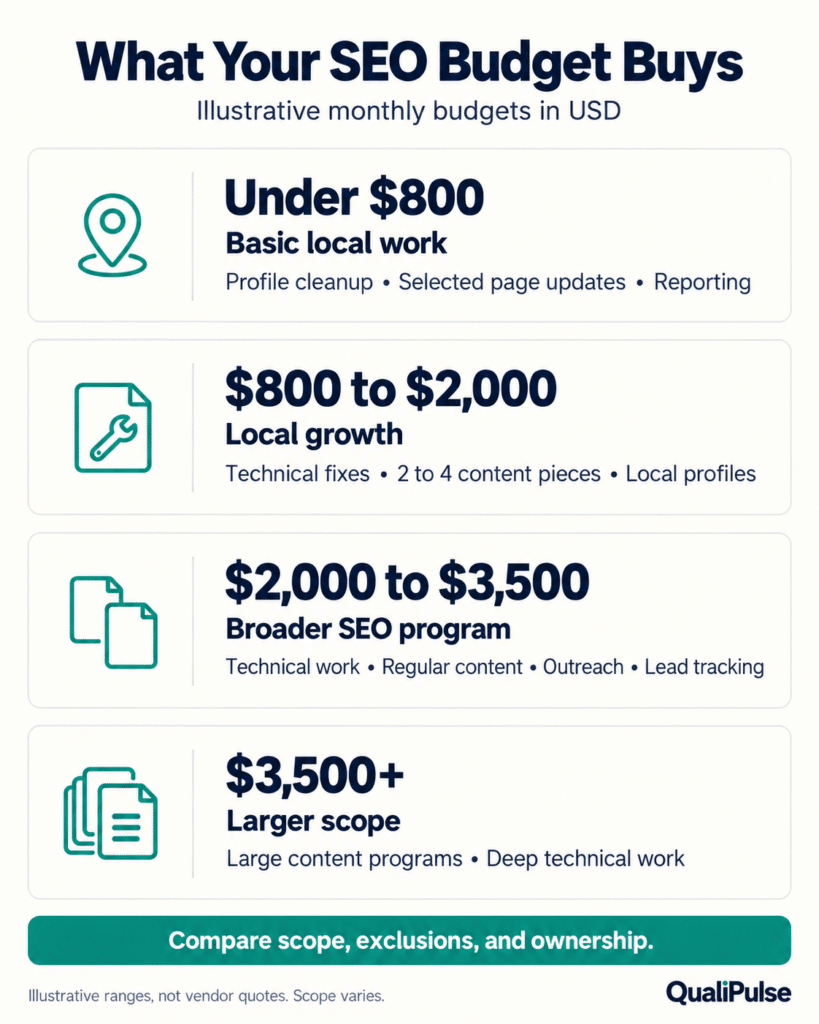
The table below shows small business SEO cost ranges I built from published 2026 figures, checked on October 11, 2026. These are not quotes from any provider. Treat them as a starting map and verify any specific vendor’s current rate before you sign.
| Monthly budget (USD) | Typical scope | Who it suits | Check before signing. |
|---|---|---|---|
| Under $800 | Profile cleanup, review requests, a few page refreshes, a monthly report | One service area, low competition, a simple offer | Stated hours or deliverables, and no setup fees hidden in the contract |
| $800 to $2,000 | Technical cleanup, two to four content pieces, modest link work, local profile management | Most local service firms and small online stores | The exact content count, who writes it, and which metrics the report tracks |
| $2,000 to $3,500 | Full technical program, regular content, link outreach, lead-based reporting | Multi-location firms, competitive niches, growing software companies | Minimum term, month-to-month option, and who owns the domain and content |
| $3,500 and up | Large content programs and deep technical work | National brands and heavily contested markets such as legal and finance | Team size, reporting cadence and exit terms |
Notice what the table leaves out: a promise of rankings. Nobody honest can guarantee them, and anyone who does is selling you a story. For a sense of how a long-form content program gets scoped for a technical audience, see the QualiPulse content engine.
Do the hours Math
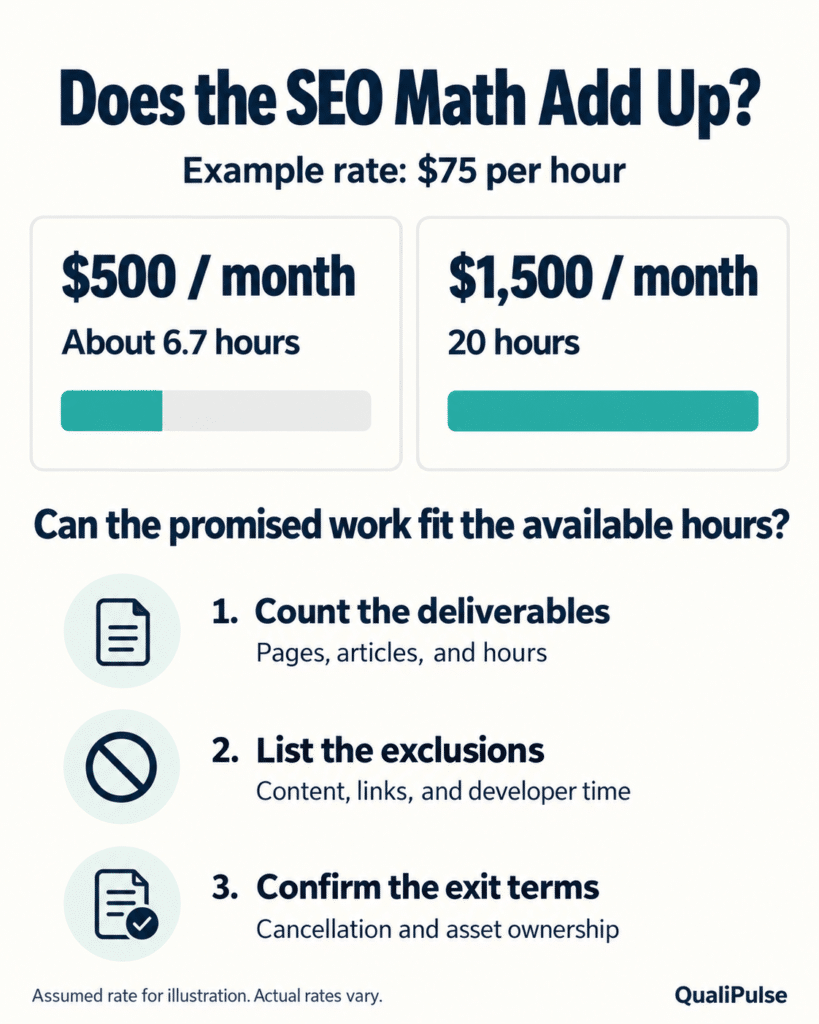
An SEO hourly rate tells you how many hours a monthly fee buys. Say a specialist bills $75 an hour. That’s a plausible rate for solid freelance work, and it’s my assumption for this example, not a sourced benchmark. A $500 retainer buys about six and a half hours. That covers a keyword pass, a few title tag fixes, and a Google Business Profile update. It does not cover four articles or link outreach.
At $1,500, the same rate buys about 20 hours. That’s enough for a real audit, a month of content, and a report you can read in ten minutes.
So ask for the hours. A provider who names them is showing you a plan. A provider who dodges the question is showing you a template. If the promised deliverables need more hours than the fee can pay for, the deliverables will be the weak part. Every time.
Get three things in writing.
Price matters less than three specifics. First, the deliverables, counted: how many pages, how many articles, and how many hours. Second, the exclusions. Does the price include content writing? Link building? Developer time for fixes? Many cheap plans quietly leave out the work that moves rankings and then bill you for it later. Third, the contract terms: minimum commitment, cancellation notice, and who owns your domain, site files, and content when you leave.
If a provider won’t put those three things in writing, their affordable SEO services aren’t worth the price.
Cheap can get expensive.
Here’s the part price guides skip. Google’s spam policies name scaled content abuse, which covers mass-producing pages without adding value, including with generative AI tools. A $300 package that ships 20 generic articles a month is not a bargain. It’s a risk to your domain that you’re paying someone providing affordable SEO Services.
Cheap works fine when the work is careful. Cheap building on volume alone can cost you rankings, and cleaning up that mess usually costs more than the savings.
Don’t buy an “AI SEO” product by accident.
Pricing is moving. An SE Ranking survey found that more than half of agencies raised prices across 2025 and 2026, with AI search work cited as the leading reason. Some of that increase is real. Some of it is relabeling.
Google’s own guidance on AI features in Search says there are no additional requirements to appear in AI Overviews or AI Mode beyond the basics. So ask your provider what they actually do on crawlability, internal links, page experience, and structured data that matches your visible text. If the answer is a premium “AI package” with no fundamentals behind it, you’re overpaying. If the answer skips the fundamentals entirely, you’re underbuying.
If your buyers research vendors on LinkedIn, our LinkedIn content for software companies covers how to build that visibility.
Commit to a horizon, not a month.
Here’s the uncomfortable truth. Most affordable SEO services assume a minimum commitment of six to 12 months. Organic growth compounds slowly. Three months at a bargain rate with no visible movement wastes money and teaches you the wrong lesson, which is that SEO doesn’t work.
Plan across at least two quarters. Then ask whether the contract turns month-to-month after the first term. Providers who allow that without penalty usually trust their own work.
For an example of how that horizon plays out with a technical audience, read our B2B content marketing work for software companies.
What affordable SEO services should deliver in the first 90 days
You shouldn’t wait six months to learn whether your provider is doing useful work. In the first month, expect a discovery phase: a site audit, a review of your existing pages, and a list of priority fixes. In the second month, the fixes should ship, and the content plan should be in motion. By the third month, you should see completed work listed clearly and early signals in your reporting, such as impressions, inquiries, or calls.
Keep the two kinds of progress separate. Completed work tells you the provider is doing the job. Business results tell you the job is working. Both matter, and only one of them shows up in month one.
The affordable SEO services option
Affordable SEO services don’t mean the lowest number. It means the hours, the scope, and the measurement line up with a result you can see in your inbox or your phone log. A $900 plan that produces three well-researched pages a month and tracks inquiries may beat a $400 plan that produces nothing you can use. A $2,500 plan is a poor buy if it only reports rankings.
Prices will keep shifting as search shifts, so treat every figure here as a snapshot. My forecast: the gap between cheap and serious SEO will widen. The cheap end will increasingly mean automated volume. The serious end will increasingly mean verified expertise and measurable outcomes.
So set a budget you can hold for six months. Ask for the hours. Get the exclusions in writing. Insist on lead-based reporting. Check what you own at the end. That’s what affordable SEO service should mean, and it’s available in the USA at prices a small business can carry.
FAQs on Affordable SEO Services
1. What are the top affordable SEO services for small businesses to improve rankings?
No single provider is best, but there is a reliable test. Look for named hours, listed exclusions, and reporting that tracks calls and inquiries as well as rankings. An affordable SEO services provider that passes all three is worth shortlisting, regardless of price or reputation.
2. What low-cost SEO companies can a small business use?
Don’t start with the brand. Start with the scope. Pick a monthly budget from the bands in this article, then ask each company what hours and deliverables that price buys. Choose the one whose work you can verify, and skip any company that can’t tell you its hours.
3. How do I tell a good SEO company from a cheap one?
Cheap usually means fewer hours, not a bargain. Check three things: whether the deliverables are counted, whether the exclusions are in writing, and whether the contract lets you leave with your domain and content. A good provider welcomes those questions. A cheap one tends to dodge them.
4. Who do people recommend for affordable SEO services, and can I trust those recommendations?
Recommendations from strangers online reflect one client’s experience, in one market, at one budget. Treat them as leads, not verdicts. Before you act, ask for two references in your size and industry, and compare the work they describe with your goals.
5. What is the average monthly SEO budget for a small business?
For most small businesses, a realistic range is $800 to $2,000 a month. Single-area local firms usually land at the lower end, while multi-location or competitive niches need more. Set a budget you can hold for six months, not one month.
6. Should a small business hire an SEO agency or a freelancer?
A freelancer may cost less per hour, but their capacity depends on one person. An agency usually brings several specialists and provides coverage when someone leaves, at a higher price. Choose whoever has the hours to do the work you’re buying, and confirm who owns your domain and content before you sign.