
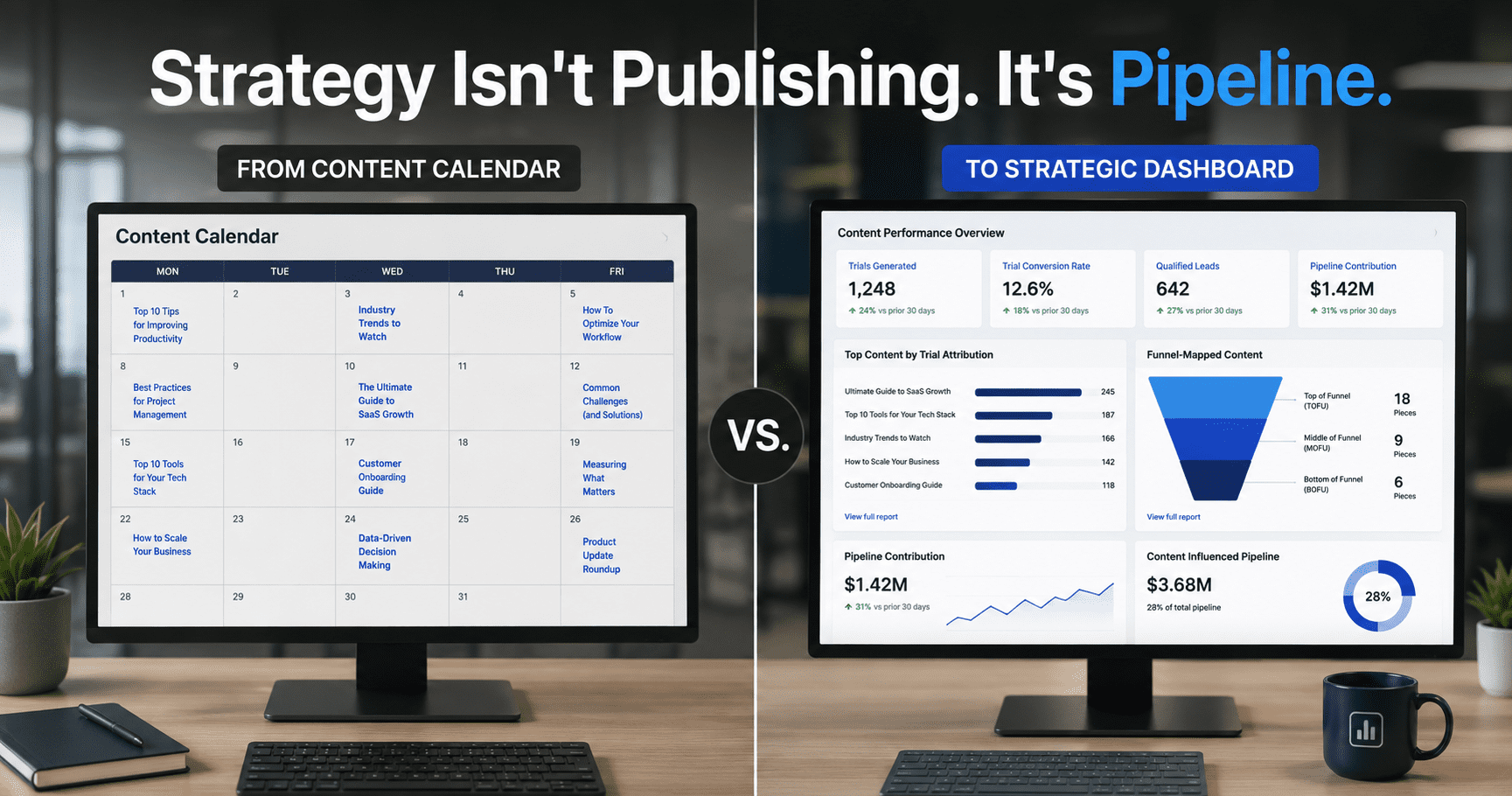
Your content strategist sends you this month’s calendar. Twelve blog posts scheduled. Three webinars planned. Two case studies in progress. Your trial signups are exactly where they were six months ago.
This is the SaaS content strategist problem. Most people in this role came from B2B marketing or journalism. They know how to create content. They don’t know how to connect content to trial velocity, expansion revenue, or customer lifetime value. According to recruitment research on SaaS content roles, SaaS sales cycles stretch 3-18 months across multiple stakeholders. Generic content marketers who are used to shorter decision cycles can’t build for this complexity.
This guide walks you through what a SaaS content strategist actually does when they understand subscription business models, how to evaluate candidates who claim SaaS expertise, and why the skills that make someone good at content marketing make them terrible at SaaS content strategy.
What A SaaS Content Strategist Actually Does (Versus What They Say They Do)
Here’s what breaks when you hire a traditional content strategist for a SaaS company: they build for awareness when you need conversion velocity.
A real SaaS content strategist starts with your customer acquisition economics. What’s your current CAC? What’s your trial-to-paid conversion rate? How long does it take a trial user to reach their first value moment? Which features drive expansion revenue? Without these numbers, they’re just guessing about content priorities.
They map content to the dual-timeline funnel. Self-serve users who need product education content that reduces time-to-value. Enterprise buyers who need ROI calculators, security documentation, and case studies proving you can handle their scale. Traditional strategists build one funnel for everyone. SaaS strategists build parallel content tracks for different buyer personas.
They prioritize bottom-of-funnel content first. Not thought leadership. Not industry trends. Comparison pages that capture users actively evaluating alternatives. Use case guides that rank for job-to-be-done searches. Integration tutorials that surface when users search implementation questions. According to research from content agencies specializing in SaaS, most content strategists lack experience building signup-driven content strategies. They optimize for traffic volume because that’s what they know how to measure.
They connect content to revenue through attribution tracking. Multi-touch attribution models that show which pieces influenced trial signups. Cohort analysis comparing users who engaged with onboarding content versus those who didn’t. Expansion MRR tied to feature adoption articles. If your strategist can’t explain how content contributed to last quarter’s bookings, they’re producing content without knowing if it works.
The Five Skills That Separate Real SaaS Content Strategists From Bloggers With LinkedIn Profiles
When you’re evaluating candidates, these five capabilities expose the difference between someone who understands SaaS and someone who Googled ‘SaaS content strategy’ before the interview.
Skill 1: They Speak Your Product Team’s Language
Real SaaS content strategists sit in product syncs. They understand your feature roadmap, your API architecture, your integration capabilities. They know which features drive expansion revenue and which ones reduce churn. When a new feature ships, they don’t need product marketing to explain it. They’ve been in the planning meetings.
This matters because the best SaaS content is product-led. A guide on ‘how to automate customer support ticket routing’ that naturally shows your workflow automation features converts better than a generic article about support automation with a CTA stapled on. Product fluency is the difference between educational content and conversion content.
Skill 2: They Build For Buying Committees, Not Individual Searchers
B2B SaaS purchases involve developers who test the product, managers who evaluate alternatives, and executives who approve budgets. Your content needs to serve all three simultaneously.
A strategist who understands this builds separate content tracks. Technical documentation for developers searching implementation questions. ROI calculators for managers comparing solutions. Case studies for executives doing due diligence. Then they structure internal linking so each persona can discover content relevant to other stakeholders. Traditional strategists write for ‘the target audience’ as if it’s one person.
Skill 3: They Prioritize Content Based On Pipeline Impact, Not Keyword Volume
Ask a candidate how they prioritize the content calendar. The wrong answer mentions search volume, traffic potential, or competitor gap analysis. The right answer starts with customer acquisition economics.
They should explain why a comparison page ranking for ‘Salesforce alternatives’ drives more qualified trials than a high-volume educational guide about CRM best practices. Why integration tutorials convert better than thought leadership. Why feature adoption content reduces churn more than industry trend reports. If they can’t connect content types to SaaS metrics, they’re optimizing for the wrong outcome.
Skill 4: They Understand Content For The Entire Customer Lifecycle
Most content strategists only think about acquisition. SaaS strategists build content for onboarding, activation, feature adoption, expansion, and retention.
Onboarding guides that reduce time-to-first-value. Feature tutorials that drive expansion revenue when users upgrade for advanced capabilities. Best practice articles that prevent churn by helping users extract more value. Integration documentation that increases stickiness. Acquisition content fills the top of the funnel. Lifecycle content drives the economics that make SaaS profitable.
Skill 5: They Track The Right Metrics And Know How To Improve Them
Page views don’t matter. Rankings don’t matter. What matters is trial signups attributed to organic search, time-to-value for users who came through content, trial-to-paid conversion rates for organic users versus other channels, expansion MRR from customers who engaged with product education, and churn rates for users who completed onboarding content.
A good SaaS content strategist can show you a dashboard proving organic search contributed X trials last quarter with Y% conversion to paid customers. If they’re showing you Google Analytics traffic charts, they’re measuring the wrong thing.
What You Should Actually Pay A SaaS Content Strategist (And What You Get At Each Salary Band)
SaaS content strategist salaries range from $70,000 to $140,000 depending on experience, market, and whether they’re building strategy or also executing.
At $70,000-$85,000, you’re hiring someone with 2-4 years of content marketing experience who’s transitioning into SaaS. They understand content fundamentals but you’ll need to teach them subscription economics. Expect them to own editorial calendars, coordinate with writers, and track basic metrics. They can execute a strategy but probably can’t build one from scratch.
At $90,000-$110,000, you’re hiring a mid-level strategist with proven SaaS experience. They’ve built content programs at other subscription companies and understand how to map content to funnel stages. They can set up attribution tracking, prioritize content based on pipeline impact, and work cross-functionally with product and sales teams. This is the tier for most growth-stage SaaS companies.
At $120,000-$140,000, you’re hiring a senior strategist who can own content as a revenue channel. They’ve scaled organic search from 10% of trials to 25%+ at previous companies. They build multi-touch attribution models, run cohort analyses, and present content ROI to your board. They probably came from a product marketing or growth marketing background before specializing in content.
The mistake most SaaS companies make is hiring at the $70K tier and expecting $110K output. A junior strategist will produce content. It just won’t be the right content targeted at the right keywords structured to convert the right users. You’ll spend 18 months learning this while your competitors build actual pipeline from organic search.
How To Interview SaaS Content Strategist Candidates (The Questions That Expose Pretenders)
Ask these five questions. The answers will tell you if you’re talking to someone who understands SaaS or someone who added ‘SaaS experience’ to their resume last week.
Question 1: Walk me through how you’d prioritize our first 90 days of content. The right answer starts with understanding your CAC, trial conversion rates, and customer journey. They should ask about your ICP, competitive differentiation, and current funnel performance before suggesting any content. If they immediately pitch blog topics, they don’t understand strategy.
Question 2: How do you measure content success for a SaaS company? The wrong answer mentions traffic, rankings, or engagement. The right answer covers trial attribution, cohort conversion analysis, time-to-value metrics, expansion revenue correlation, and CAC payback periods. They should explain how they’ve connected content to closed revenue at previous companies.
Question 3: Show me a content program where you drove measurable trial growth. Not traffic growth. Trial attribution. They should have screenshots, dashboards, or reports proving organic search contributed X% of trials with Y conversion rate to paid. If they can’t produce this proof, they’ve never actually scaled a SaaS product through content.
Question 4: How do you build content for multiple buyer personas in the same purchase decision? This exposes whether they understand buying committees. The right answer explains creating separate content tracks for technical evaluators versus economic buyers, structuring internal linking between persona-specific content, and why some content targets product usage while other pieces address procurement concerns.
Question 5: What’s your timeline for meaningful pipeline contribution from content? The honest answer is 6-9 months for measurable trial attribution. Anyone promising results in 90 days doesn’t understand how long it takes to rank content, earn authority, and build enough traffic volume to impact trials. This question separates realists from people who will overpromise and underdeliver.
When To Hire A SaaS Content Strategist Versus Working With An Agency
Here’s the math that decides this question: a full-time content strategist costs $110K salary plus $30K benefits plus $15K tools and contractors equals $155K annually. A good SaaS content agency costs $6K-$10K monthly or $72K-$120K annually.
Hire in-house when you’re above $20M ARR with dedicated budget for a content team of 3+ people. Below that threshold, agencies deliver more capability per dollar because they bring specialized expertise, tool access, and faster execution velocity without the overhead of benefits and management.
The hybrid model works best for most SaaS companies. Agency handles strategy, high-value content creation, and link building. In-house person manages the relationship, creates product-specific content, and owns ongoing optimization. This gives you strategic depth without burning $155K annually on someone who might leave after 18 months.
The one case where you need full-time in-house is if your product requires deep technical knowledge that takes months to learn. Developer tools, infrastructure software, security platforms. An agency can’t write credible technical content about Kubernetes networking without significant ramp time. In-house makes sense when domain expertise is the bottleneck.
Frequently Asked Questions
What’s the difference between a content strategist and a content manager?
Content managers execute. Content strategists decide what to execute. A manager coordinates writers, tracks deadlines, and publishes content on schedule. A strategist determines which content to create based on business objectives, maps content to funnel stages, and connects content performance to revenue metrics. In smaller SaaS companies, one person does both. In growth-stage companies, these are separate roles.
Do SaaS content strategists need to know how to write?
Yes, but writing isn’t their primary job. They need to write content briefs that explain positioning, messaging, and SEO requirements. They should be able to edit drafts from writers to ensure quality. But if your strategist is spending 50% of their time writing, you’ve hired a writer with a fancy title. Strategists think. Writers execute. Both skills matter but they’re different jobs.
How long does it take to see results from a new content strategist?
Expect 3-6 months to see process improvements like better content briefs, clearer prioritization, and attribution tracking setup. Expect 6-12 months to see pipeline impact from the content they plan. A good strategist will show quick wins in months 1-3 by optimizing existing content or launching high-intent comparison pages, but the full compounding effect takes a year.
Should a SaaS content strategist report to marketing or product?
Marketing, but they need direct access to product. Reporting to marketing aligns them with acquisition goals and gives them budget authority. But the best SaaS content is product-led, which requires regular collaboration with product teams. The ideal structure is marketing reporting with dotted-line accountability to product for feature launches and product education content.
What tools should a SaaS content strategist know?
SEO platforms like Ahrefs or Semrush for keyword research and competitive analysis. Analytics tools including Google Analytics, Mixpanel, or Amplitude for tracking user behavior. CRM integration to connect content to pipeline. Content management systems for publishing. Attribution platforms like HubSpot or Salesforce for multi-touch tracking. Project management tools like Asana or Notion. The specific tools matter less than understanding how to extract insights from data.
Can a content strategist also handle social media and email marketing?
At early-stage companies under $5M ARR, yes. One person wears multiple hats. Above that scale, no. Content strategy for SEO and organic growth requires different skills than social media engagement or email nurture campaigns. Trying to do all three means doing none of them well. As you grow, content strategy becomes a full-time specialization focused on building organic acquisition channels.
What background should a SaaS content strategist have?
The best SaaS content strategists came from product marketing, growth marketing, or technical writing backgrounds before specializing in content. They understand how products are built, how customers adopt them, and how to measure business impact. Avoid candidates who only have editorial or journalism experience unless they’ve spent 3+ years specifically in B2B SaaS. Writing skills transfer. Strategic thinking about subscription economics doesn’t.
Most SaaS companies hire content strategists based on writing samples and content marketing experience. Then they spend 12 months watching that person produce content nobody reads and trials that stay flat.
The strategists who understand SaaS don’t pitch blog calendars in the first meeting. They ask about your CAC, trial conversion rates, and customer journey length. They want to see your product, talk to your sales team, and understand which features drive expansion revenue. They know content is a revenue channel, not a publishing schedule.
Before you hire, ask the five questions from this guide. Demand proof of trial attribution, not traffic growth. Make sure they can explain how content will contribute to your next board deck, not just your marketing dashboard. And be honest about whether you need a full-time strategist or if an agency partnership delivers more capability for the money.
QualiPulse works with B2B SaaS companies that need content strategy connected to pipeline, not vanity metrics. We audit your current content performance, identify the highest-impact gaps in your funnel, and show you exactly how content should drive trial velocity and expansion MRR. Most clients see measurable improvements in content-to-trial attribution within 6 months because we start with bottom-of-funnel content and proper tracking. Book your free 30-minute SaaS content strategy audit.