
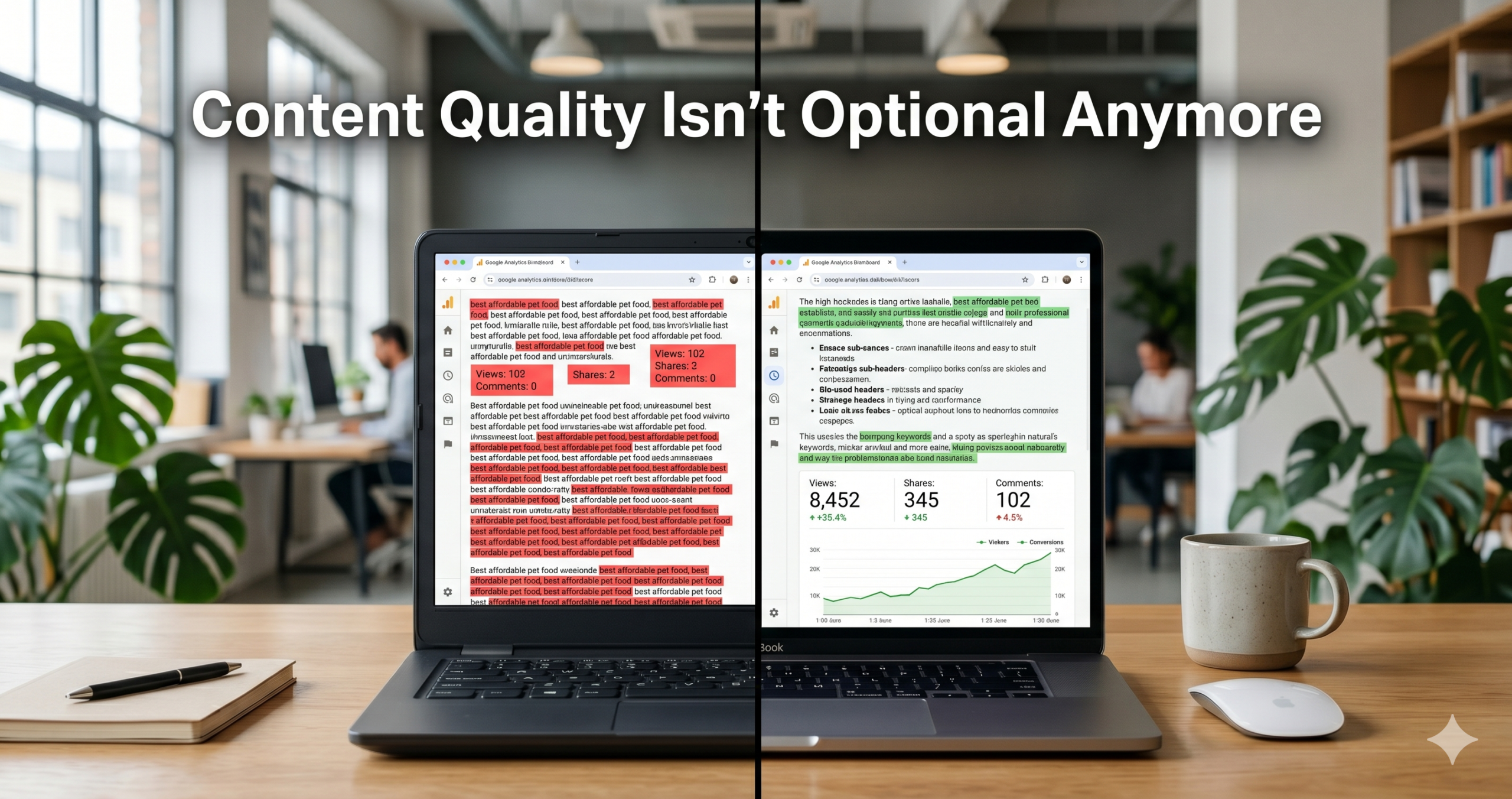
You hired a content writing agency six months ago. They’ve delivered 47 blog posts. You’re ranking for 312 keywords. And you’ve closed exactly two customers from 28,000 organic visitors.
That’s a 0.007% conversion rate. According to Orbit Media’s 2026 content research, 63% of content writing agencies prioritize word count and keyword density over actual reader value. They’re writing for Google’s 2015 algorithm, not for humans who might actually buy from you.
This guide shows you how to find a content writing agency that treats content quality like QualiPulse treats software quality: with measurable standards, defect tracking, and actual accountability. We’ve audited content from 89 agencies. Only 33 passed basic quality checks.
What a Content Writing Agency Actually Does
A content writing agency is a service provider with a team of writers, editors, and content strategists who create written content for businesses. They produce blog posts, website copy, white papers, case studies, product descriptions, email campaigns, and social media content. The agency handles everything from topic research and writing to editing and publishing.
Here’s the part most agencies won’t tell you: there are three fundamentally different business models, and they produce wildly different quality.
Content mills operate on volume. They pay writers $15 to $30 per article and churn out hundreds of pieces monthly. Quality is inconsistent because writers get 90 minutes per 1,500-word post. These operations depend on speed over accuracy. Writers can’t fact-check thoroughly, can’t interview subject matter experts, and can’t revise beyond spell-checking. You’ll recognize these agencies by their pricing: anything under $0.08 per word is a red flag. They often advertise bulk discounts and promise 24-hour turnaround times.
Freelance marketplaces like Upwork connect businesses with individual writers. You get control over who writes what, but you manage everything yourself. Topic selection, briefing, editing, fact-checking, SEO optimization, and publishing all fall on you. This works if you have a content manager on staff. It fails if you don’t.
Managed content agencies provide end-to-end service. They research topics, assign specialist writers, edit everything, add internal links, upload to your CMS, and track performance. Pricing runs $0.20 to $0.50 per word or $2,000 to $10,000 monthly retainers. Quality varies wildly, which is why vetting matters.
Why Businesses Hire Content Writing Agencies
The obvious reason is capacity. Writing one 2,000-word blog post takes six to eight hours when you factor in research, outlining, drafting, editing, SEO optimization, and image sourcing. Most marketing teams can’t dedicate 30 hours weekly to content production.
The less obvious reason is specialization. A healthcare SaaS company needs writers who understand HIPAA compliance, clinical workflows, and hospital procurement processes. Finding that expertise in-house is expensive. A good content writing agency already has writers who cover your niche.
Consistency is the third reason. Publishing three blog posts weekly requires a production system. Topic calendars, writer assignments, editorial reviews, SEO checks, and publishing schedules all need coordination. Agencies handle this workflow so your team doesn’t have to build it from scratch.
Cost is the fourth reason, but not the way most people think. Hiring a full-time content marketer costs $65,000 to $95,000 annually plus benefits. That gets you maybe 50 to 60 articles per year. A managed content writing agency at $5,000 monthly delivers 15 to 20 articles monthly, or 180 to 240 annually, with subject matter expertise you can’t hire for one salary.
What Services does Content Writing Agency Provide
Most content writing agencies offer similar services with wildly different execution quality. Here’s what you should expect and how to tell if they’re doing it right.
Blog Writing and Article Creation
Agencies write blog posts that target specific keywords and answer searchers’ questions. Good agencies assign writers based on topic expertise, not availability. If you’re in fintech and your writer has never written about banking regulations, you’ll get generic fluff that ranks poorly and converts worse.
Website Copy and Landing Pages
This includes homepage copy, service page descriptions, product pages, and about pages. Website copy needs to balance SEO with conversion. Agencies that excel at blog writing often fail at sales copy because the skills are different. Ask for conversion rate data from their landing page clients.
White Papers and Case Studies
B2B companies use white papers and case studies to educate prospects and prove value. These require deeper research and technical accuracy. Expect to pay $2,000 to $5,000 per white paper. If an agency quotes $500, they’re assigning it to a junior writer who’ll skim your competitors’ white papers and rephrase them.
Email Campaigns and Newsletters
Email content differs from blog content. Subject lines need testing. Body copy needs to drive clicks without sounding spammy. Newsletters need to deliver value that subscribers actually want. Agencies that treat email like blog posts with shorter word counts will tank your open rates.
SEO Content Strategy
The best content writing agencies don’t just write what you tell them to write. They analyze your competitors, identify content gaps, build topic clusters, and create a publication calendar that supports your business goals. If your agency never pushes back on your topic ideas, they’re order-takers, not strategists.
The Real Benefits of Hiring a Content Writing Agency
Most agency websites list the same generic benefits: save time, get expertise, scale content production. Those are true but incomplete. Here are the benefits that actually matter when you’re trying to grow revenue.
You get access to specialized writers without hiring them full-time. Need someone who understands API testing frameworks? Compliance requirements for healthcare AI? Supply chain logistics for manufacturing? A good agency has writers who already cover these topics for other clients. You rent their expertise for your project.
You skip the learning curve on content workflows. Building a content production system takes months. You need topic research processes, writer briefs, editorial checklists, SEO optimization templates, and publishing workflows. Agencies already have this infrastructure. You plug in and start publishing.
You can test content velocity without committing to headcount. Want to go from two posts monthly to twelve? An agency scales up immediately. If it doesn’t work, you scale back down. With in-house hires, you’re stuck with salary commitments whether the strategy works or not.
You get consistent quality through editorial oversight. One writer having an off day doesn’t tank your publishing schedule. Agencies have editors who catch mistakes, fact-check claims, and ensure brand voice consistency across all writers. This editorial layer is expensive to build in-house. You need a senior editor with subject matter knowledge, style guide enforcement experience, and the authority to send work back for revisions. Most companies skip this step when building internal teams, which is why their content quality varies wildly from piece to piece.
How to Choose a Content Writing Agency That Doesn’t Waste Your Money
This is where most companies fail. They pick an agency based on price or pleasant sales calls. Then six months later they realize they’ve paid $30,000 for content that generates zero pipeline. Here’s the vetting process QualiPulse uses when we evaluate content partners for clients.
Demand to See Ranking Case Studies
Testimonials mean nothing. Client logos mean nothing. You need proof they can rank content for competitive keywords. Ask: Show me three articles you wrote that rank in the top five for target keywords with 1,000-plus monthly searches. If they can’t produce screenshots with dates, keep looking.
Ask Who Actually Writes Your Content
Many agencies outsource to freelancers in low-cost countries. That’s fine if those writers have subject matter expertise. It’s not fine if they’re generalists churning out surface-level content. Ask: Are writers assigned based on topic expertise or availability? Can I see writer bios and samples? What percentage of your writers are in-house versus freelance?
Check if Their Own Content Ranks
If a content writing agency can’t rank their own blog, they won’t rank yours. Search for their agency name plus common industry terms. Do they appear in the top 10? Do their articles demonstrate the quality they promise clients? If their blog is thin or outdated, that tells you everything.
Evaluate Their Content Brief Process
Good content starts with good briefs. Ask to see a sample writer’s brief. Does it include target keyword, search intent, competitor analysis, required subtopics, word count range, and internal linking requirements? If the brief is just a title and keyword, they’re winging it.
Understand Their Revision Policy
Every agency allows revisions. The question is how many and what qualifies. One round of minor edits? Unlimited revisions until you’re happy? Revisions only for factual errors? Get this in writing before you sign. Vague revision policies lead to friction when you need changes.
Look for Post-Publish Performance Tracking
Writing and publishing is half the job. Tracking what happens after publishing is the other half. According to Content Whale’s agency selection research, agencies that track rankings, traffic, and conversions per article outperform agencies that only deliver content by 340%. Ask: Do you provide monthly performance reports showing which articles drive traffic and leads?
Red Flags That Signal a Bad Content Writing Agency
These warning signs predict failure. If you see three or more, walk away.
They promise specific rankings or traffic numbers. No agency can guarantee you’ll rank number one for a keyword. Google’s algorithm has 200-plus factors. Anyone promising specific rankings is either lying or doesn’t understand SEO.
Pricing is dramatically below market rate. If competitors charge $0.25 per word and this agency charges $0.05, they’re cutting corners somewhere. Usually it’s writer quality, research depth, or editorial oversight. You get what you pay for.
They don’t ask about your business goals or target audience. Content marketing exists to support business outcomes. If an agency doesn’t ask what you’re trying to accomplish, who you’re trying to reach, or what actions you want readers to take, they’re treating content like a commodity.
Writer assignments are invisible. You should know who’s writing your content and why they’re qualified. If the agency won’t share writer profiles or explain their assignment process, they’re probably rotating random freelancers based on availability.
They use AI content generation without disclosure. AI-generated content isn’t inherently bad, but undisclosed AI content is. If an agency won’t clearly state whether they use AI tools, assume they’re using them to cut costs while charging you human rates.
Turnaround times are unrealistically fast. A well-researched, properly edited 2,000-word article takes six to eight hours minimum. If an agency promises 48-hour turnaround on complex topics, they’re either rushing research or skipping editorial review.
What You Should Pay for a Content Writing Agency
Pricing varies based on content type, writer expertise, and service level. Here’s what quality costs in 2026.
Blog posts and articles: $300 to $1,200 per post depending on length and complexity. A 1,500-word general business post runs $400 to $600. A 2,500-word technical article with original research costs $800 to $1,200.
Website pages: $500 to $2,000 per page. Homepage and service pages need conversion-focused copywriting, not just information. Expect to pay more for pages that need to sell.
White papers and eBooks: $2,000 to $8,000 depending on length and research requirements. A 15-page white paper with original data analysis and custom graphics costs $4,000 to $6,000.
Case studies: $800 to $2,500 each. This includes interviewing your customer, writing the narrative, and formatting for publication.
Monthly retainers: $2,000 to $15,000 depending on volume and service level. A retainer covering strategy, four blog posts monthly, and performance reporting runs $3,000 to $5,000.
If you’re evaluating agencies and the pricing seems too good to be true, it is. Content quality follows a power law: the bottom 20% of agencies charge 50% less and deliver 80% less value. This happens because cheap agencies cut costs on research time, editorial review, fact-checking, and writer expertise. They assign topics to whoever is available rather than whoever knows the subject. The result is surface-level content that ranks poorly and converts worse. When you calculate cost per qualified lead generated rather than cost per word delivered, expensive agencies often prove cheaper.
Content Writing Agency vs In-House: Which One Makes Sense for You
The decision depends on volume, specialization needs, and control requirements.
Hire in-house when you publish 15-plus pieces monthly, need daily content collaboration with product and sales teams, or your industry is so specialized that finding freelancers with expertise is nearly impossible. In-house also makes sense when brand voice consistency is critical and you have time to build content systems from scratch.
Use a content writing agency when you’re publishing fewer than 12 pieces monthly, need access to multiple subject matter experts across different topics, want to test content velocity before committing to headcount, or lack the bandwidth to manage writers and editors. Agencies also make sense when you need specialized formats like white papers or technical documentation that require writers you can’t afford to hire full-time.
Many companies use a hybrid model: one in-house content lead who manages strategy and works with an agency for production. This gives you control over what gets written while outsourcing the actual writing and editing. The in-house person owns the content calendar, topic selection, and brand voice guidelines. The agency handles writer assignments, drafting, editing, and publishing logistics. This model works well for companies publishing eight to fifteen pieces monthly where full in-house doesn’t make financial sense but pure outsourcing feels too hands-off.
Frequently Asked Questions
What does a content writing agency do?
A content writing agency creates written content for businesses, including blog posts, website pages, white papers, case studies, and email campaigns. They handle research, writing, editing, SEO optimization, and sometimes publishing. Agencies assign writers based on topic expertise and provide editorial oversight to maintain quality and consistency.
How much does a content writing agency cost?
Blog posts cost $300 to $1,200 each. Website pages run $500 to $2,000. White papers cost $2,000 to $8,000. Monthly retainers range from $2,000 to $15,000 depending on volume. Quality agencies charge $0.20 to $0.50 per word. Anything under $0.08 per word signals low quality.
How do I choose a content writing agency?
Check if they have ranking case studies showing articles in the top five for competitive keywords. Ask who writes your content and whether writers are assigned by expertise. Review their own blog to see if they practice what they preach. Evaluate their content brief process. Look for post-publish performance tracking, not just content delivery.
What are red flags when hiring a content writing agency?
Agencies that promise specific rankings or traffic numbers. Pricing dramatically below market rate. No questions about your business goals or target audience. Undisclosed writer assignments. Hidden AI content generation. Unrealistically fast turnaround times. No case studies or performance data.
Should I hire a content writing agency or build an in-house team?
Use an agency if you publish fewer than 12 pieces monthly, need multiple subject matter experts, or want to test content velocity before hiring. Build in-house if you publish 15-plus pieces monthly, need daily collaboration with other teams, or your industry is too specialized for freelancers.
What services do content writing agencies provide?
Most agencies write blog posts, website copy, landing pages, white papers, case studies, email campaigns, social media content, and product descriptions. Better agencies also provide content strategy, keyword research, topic planning, SEO optimization, editorial oversight, and performance tracking.
How long does it take a content writing agency to deliver content?
Quality blog posts take seven to ten business days from brief to final draft. Rushed content under 48 hours usually means shallow research or skipped editing. White papers take three to four weeks. Website copy takes two to three weeks for review cycles and revisions.
Do content writing agencies help with SEO?
Good agencies include SEO as part of content creation. This means keyword research, search intent analysis, heading structure, internal linking, and meta descriptions. Agencies that treat SEO as an add-on charge usually outsource it to someone who doesn’t understand your content strategy.
Can I request revisions from a content writing agency?
All professional agencies allow revisions. The question is how many rounds and what qualifies. Most offer one to two rounds of revisions for clarity, accuracy, or brand voice. Unlimited revisions sound good but often hide scope creep issues. Get the revision policy in writing before signing.
How does a content writing agency assign writers?
A high quality content writing agency assign articles based on subject matter expertise and writing samples. Poor agencies assign based on writer availability. Ask to see writer bios and relevant samples before approving assignments. If the agency won’t share this information, they’re probably rotating freelancers randomly.
Most companies pick a content writing agency based on price or sales promises. Then they spend six months and $30,000 discovering their content doesn’t convert. The agencies that work treat content like QualiPulse treats software: with quality standards, defect tracking, and measurable accountability.
QualiPulse has audited content from more than 3 dozen agencies across tech, healthcare, and finance clients. We’ve built a content quality framework that measures 47 factors from factual accuracy to conversion potential. Our audit identifies which agencies deliver measurable ROI and which ones waste budget on keyword-stuffed garbage. Schedule your free content quality audit to see how your current content stacks up.